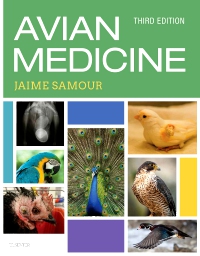

Avian Medicine - Elsevier eBook on VitalSource, 3rd Edition
Elsevier eBook on VitalSource
Set your students up for success in the field of avian care with the third edition of Jaime Samour’s widely-trusted Avian Medicine. Combining the in-depth information found in a textbook with the practicality of a hands-on manual and the highly visual format of an atlas, this comprehensive text equips your students with all the knowledge and insights needed to successfully care for a wide variety of avian species — including psittacines, raptors, bustards, parrots, finches, and more. Coverage includes issues ranging from the basic aspects of patient management to the most sophisticated diagnostic techniques. Plus, with more illustrations, a wealth of practical advice, and the latest information on cutting-edge treatments and procedures incorporated into this new edition, your students will have all of the tools they need to effectively and confidently care for birds in professional practice.
-
- NEW! New chapter sections, revised references, and updated suggested readings ensure that readers have the most up-to-date information.
- NEW! New chapter contributors ensure the information in the text reflects the most current techniques and advances.
- NEW! Expanded content on parrots, finches and fruit-eating birds has been added to the text to make content more relevant to the needs of today’s practitioners.
- NEW! Thoroughly updated content includes the latest surgical techniques and procedures to keep practitioners on top of the most cutting-edge information in the field.
- NEW! Additional content and images on MRI have been incorporated throughout the text to complete the coverage of other advanced imaging techniques such as CT scans.
-
- NEW! New chapter sections, revised references, and updated suggested readings ensure that students have the most up-to-date information.
- NEW! The most current techniques and advances are presented by leading experts in the field.
- Comprehensive coverage of all aspects of clinical management written by leading experts in the field provides students with a depth and breadth of knowledge on avian medicine and care.
- Coverage of a wide variety of species — including raptors, bustards, and many others — enables students to treat a greater assortment of patients with more confidence and skill.
- NEW! Expanded content on parrots, finches, and fruit-eating birds has been added to the text to make content more relevant to the needs of today’s vet students.
- NEW! Thoroughly updated content includes the latest surgical techniques and procedures to keep students on top of the most cutting-edge information in the field.
- NEW! Additional content and images on MRI have been incorporated throughout the text to complete the coverage of other advanced imaging techniques such as CT scans.
- Bulleted text and tables help present information in an accessible way.
- More than 900 color images give students a better picture of disease and how it will be encountered in practice.
- Appendices bring together wide-ranging data on hematology and blood chemistry reference values, commonly used pharmaceutics and other information relevant to avian practitioners.
-
-
 Avian MedicineHardcover
-
-
1. Housing, Environment and Public Awareness
2. Avian Intelligence, Clinical Behavior and Welfare
3. Nutrition and Nutritional Management
4. Capture and Handling
5. The Clinical Examination
6. Clinical and Laboratory Diagnostic Examination
7. Anesthesia and Analgesia
8. Medical, Nursing and Cosmetic Procedures
9. Trauma-Related Medical Conditions
10. Management-Related Medical Conditions
11. Soft Tissue Surgery
12. Orthopedic Surgery
13. Systemic Diseases
14. Infectious Diseases
15. Reproduction
16. Post-Mortem Examination
17. Forensic Investigations in Avian Medicine
Appendices
Index -
-
Ways of Reading
- The appearance of the text and page layout can be modified according to the capabilities of the reading system (font family and font size, spaces between paragraphs, sentences, words, and letters, as well as color of background and text)
- This e-publication is accessible to the full extent that the file format and types of content allow, on a specific reading device, by default, without necessarily including any additions such as textual descriptions of images or enhanced navigation
- No information about nonvisual reading is available
-
Conformance
- No information is available
-
Navigation
- Table of contents to all chapters of the text via links
- Page list to go to pages from the print source version
-
Rich Content
- No information is available
-
Hazards
- No information is available
-
Product Content
- No information is available
-
Legal Considerations
- No information is available
-
Additional Accessibility Information
- Page breaks included from the original print source
- For readers with color vision deficiency, use of color (e.g., in diagrams, graphics and charts, in prompts, or on buttons inviting a response) is not the sole means of graphical distinction or of conveying information
- E-publication includes basic navigation (usually less detailed than TOC-based navigation)
- Where links, controls or buttons are included in the content, the purpose or functionality of each link, control or button is apparent from the associated text alone - or where it is unclear, separate link, control or button descriptions are provided
- All (or substantially all) textual matter is arranged in a single logical reading order (including text that is visually presented as separate from the main text flow, e.g., in boxouts, captions, tables, footnotes, endnotes, citations, etc.). Non-textual content is also linked from within this logical reading order. (Purely decorative non-text content can be ignored).
- The language of the text has been specified (e.g., via the HTML or XML lang attribute) to optimise text-to-speech (and other alternative renderings), both at the whole document level and, where appropriate, for individual words, phrases or passages in a different language.
-
Ways of Reading

 as described in our