ISBN:
9780723439639
Copyright:
2016
Publication Date:
01-14-2016
Page Count:
240
Imprint:
Mosby Ltd.
List Price:
$72.99

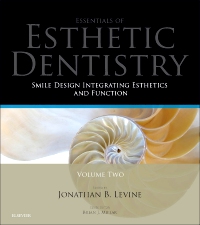
Smile Design Integrating Esthetics and Function - Elsevier eBook on VitalSource, 1st Edition
by Jonathan B Levine, DMD and Brian J Millar, BDS, FDSRCS, PhD, FHEA
Elsevier eBook on VitalSource
ISBN:
9780723439639
Copyright:
2016
Publication Date:
01-14-2016
Page Count:
240
Imprint:
Mosby Ltd.
List Price:
$72.99
Most review copies are eBooks – how fast!
A review copy request is most likely to be fulfilled as an eBook on VitalSource rather than a print product, unless no eBook is available. eBooks become available in as little as a few hours. Print products will take between 7 and 10 days to arrive. To request a print copy, please contact us through the Evolve Support Center for further assistance or contact your Elsevier Sales Rep.
-
- Experts of international renown present the latest scientifically authoritative and evidenced-based information, amply supported by a high-quality line artwork and photographic illustration
- Describes in detail assessment techniques for smile design, the use of trial procedures and the use of photography, aligners, and ceramic veneers.
- Highlights the way in which high quality esthetics can be achieved with a range of techniques.
- Emphasizes the importance of effective communication between the dentist, the oral healthcare team and the patient to ensure the patient’s and team’s expectations are appreciated, managed and met
- Designed to challenge traditional thinking, advance knowledge and expand the clinical approach to a growing discipline
- Offers a highly visual, practical approach in a unique series format
- Aims to strengthen, enhance and expand the scope of aesthetic professional practice
-
i) General overview about Smile Design - Galip Gurel
ii) Editors’ preface
Patient Assessment
1 Smile design – a three-step analysis
2 Psychological factors
3 Integration of function and esthetics
Techniques
4 Photography
5 Periodontal factors
6 Space management
7 Aligners in esthetic dentistry8 Veneers
Conclusions
9 Summing up -
-
Ways of Reading
- The appearance of the text and page layout can be modified according to the capabilities of the reading system (font family and font size, spaces between paragraphs, sentences, words, and letters, as well as color of background and text)
- This e-publication is accessible to the full extent that the file format and types of content allow, on a specific reading device, by default, without necessarily including any additions such as textual descriptions of images or enhanced navigation
- No information about nonvisual reading is available
-
Conformance
- No information is available
-
Navigation
- Table of contents to all chapters of the text via links
- Page list to go to pages from the print source version
-
Rich Content
- No information is available
-
Hazards
- No information is available
-
Product Content
- No information is available
-
Legal Considerations
- No information is available
-
Additional Accessibility Information
- Page breaks included from the original print source
- For readers with color vision deficiency, use of color (e.g., in diagrams, graphics and charts, in prompts, or on buttons inviting a response) is not the sole means of graphical distinction or of conveying information
- E-publication includes basic navigation (usually less detailed than TOC-based navigation)
- Where links, controls or buttons are included in the content, the purpose or functionality of each link, control or button is apparent from the associated text alone - or where it is unclear, separate link, control or button descriptions are provided
- All (or substantially all) textual matter is arranged in a single logical reading order (including text that is visually presented as separate from the main text flow, e.g., in boxouts, captions, tables, footnotes, endnotes, citations, etc.). Non-textual content is also linked from within this logical reading order. (Purely decorative non-text content can be ignored).
- The language of the text has been specified (e.g., via the HTML or XML lang attribute) to optimise text-to-speech (and other alternative renderings), both at the whole document level and, where appropriate, for individual words, phrases or passages in a different language.
-
Ways of Reading
Most review copies are eBooks – how fast!
A review copy request is most likely to be fulfilled as an eBook on VitalSource rather than a print product, unless no eBook is available. eBooks become available in as little as a few hours. Print products will take between 7 and 10 days to arrive. To request a print copy, please contact us through the Evolve Support Center for further assistance or contact your Elsevier Sales Rep.

 as described in our