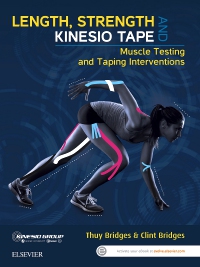

Length, Strength and Kinesio Tape - eBook, 1st Edition
Elsevier eBook on VitalSource
Length, Strength and Kinesio Tape: Muscle Testing and Taping Interventions is an essential manual for musculoskeletal therapists seeking to develop competency in the treatment of select clinical conditions using the concepts and principles of the Kinesio Taping® Method.
Focusing on the identification and role of muscle structures, the manual presents length and strength tests covering 68 muscle groups and provides practitioners with a framework to use and reassess the application of Kinesio® Tape.
Endorsed by Kinesio Taping Association International, Length, Strength and Kinesio Tape: Muscle Testing and Taping Interventions is designed as a companion to Kinesio Taping® courses globally (KT1 and KT2).
Also available as a separate purchase:
A suite of 68 videos covering 8 major body areas with step-by-step instructions and clear demonstrations of the assessment and taping strategies for each technique.
- An ideal supplement to the text
- Excellent clinician refresher tool
- Useful when explaining treatment to client
To find out more about these videos, visit elsevierhealthonline
-
- Overview of the Kinesio® method and how Kinesio Taping® works
- Highlights the anatomy of the muscle and structures prior to taping
- Step-by-step instructions to a range of Kinesio Taping® techniques, covering the neck, shoulder, elbow, wrist and thumb, trunk, pelvic girdle and hip, knee and ankle
- Initial assessment using length and strength/function testing and application of appropriate Kinesio Taping® intervention
- Assessment sheets provided for each key anatomical area
-
Chapter 1 - Introduction to Kinesio Taping and the role of muscles within the neuromyofascial-skeletal systemChapter 2 - Kinesio Taping basicsChapter 3 - Techniques for testing and taping the neckChapter 4 - Techniques for testing and taping the shoulderChapter 5 - Techniques for testing and taping the elbowChapter 6 - Techniques for testing and taping the wrist and thumbChapter 7 - Techniques for testing and taping the trunkChapter 8 - Techniques for testing and taping the pelvic girdle and hipChapter 9 - Techniques for testing and taping the kneeChapter 10 - Techniques for testing and taping the ankle
-
-
Ways of Reading
- The appearance of the text and page layout can be modified according to the capabilities of the reading system (font family and font size, spaces between paragraphs, sentences, words, and letters, as well as color of background and text)
- This e-publication is accessible to the full extent that the file format and types of content allow, on a specific reading device, by default, without necessarily including any additions such as textual descriptions of images or enhanced navigation
- No information about nonvisual reading is available
-
Conformance
- No information is available
-
Navigation
- Table of contents to all chapters of the text via links
- Page list to go to pages from the print source version
-
Rich Content
- No information is available
-
Hazards
- No information is available
-
Product Content
- No information is available
-
Legal Considerations
- No information is available
-
Additional Accessibility Information
- Page breaks included from the original print source
- For readers with color vision deficiency, use of color (e.g., in diagrams, graphics and charts, in prompts, or on buttons inviting a response) is not the sole means of graphical distinction or of conveying information
- E-publication includes basic navigation (usually less detailed than TOC-based navigation)
- Where links, controls or buttons are included in the content, the purpose or functionality of each link, control or button is apparent from the associated text alone - or where it is unclear, separate link, control or button descriptions are provided
- All (or substantially all) textual matter is arranged in a single logical reading order (including text that is visually presented as separate from the main text flow, e.g., in boxouts, captions, tables, footnotes, endnotes, citations, etc.). Non-textual content is also linked from within this logical reading order. (Purely decorative non-text content can be ignored).
- The language of the text has been specified (e.g., via the HTML or XML lang attribute) to optimise text-to-speech (and other alternative renderings), both at the whole document level and, where appropriate, for individual words, phrases or passages in a different language.
-
Ways of Reading

 as described in our