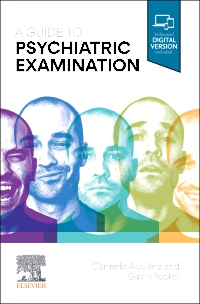
ISBN:
9780729589185
Copyright:
2021
Publication Date:
08-04-2021
Page Count:
842
Imprint:
Elsevier
List Price:
$40.99

A Guide to Psychiatric Examination - E-Book, 1st Edition
by Carmelo Aquilina, MD, FRCPsych, FRANZCP and Gavin Tucker, MB BCh BAO, MSc
Elsevier eBook on VitalSource
ISBN:
9780729589185
Copyright:
2021
Publication Date:
08-04-2021
Page Count:
842
Imprint:
Elsevier
List Price:
$40.99
Most review copies are eBooks – how fast!
A review copy request is most likely to be fulfilled as an eBook on VitalSource rather than a print product, unless no eBook is available. eBooks become available in as little as a few hours. Print products will take between 7 and 10 days to arrive. To request a print copy, please contact us through the Evolve Support Center for further assistance or contact your Elsevier Sales Rep.
-
- Practical guidance on writing reports and communicating your findings effectively
- Starts from first principles to give a sound foundation for all psychiatric interviews
- Covers all mental health conditions with both DSM-V and ICD-11 classifications
- Key topics such as risk assessments, managing difficult encounters, home visits, practising safely
- Insights into how it feels to be interviewed written by a patient
-
-
 A Guide to Psychiatric ExaminationPaperback
-
-
Chapter 1.Being interviewed: the psychiatric assessment as a co-constructed relationship
Section 1:The basics
Chapter 2.Information gathering
Chapter 3.Becoming a skilled interviewer
Section 2:The diagnostic psychiatric interview
Chapter 4.Preparing for the interview
Chapter 5.The diagnostic interview
Chapter 6.The mental state examination
Chapter 7.Bringing it all together
Chapter 8.Recording and communicating your assessment to others
Section 3:Specific presentations
Chapter 9.Depression
Chapter 10.The suicidal person
Chapter 11.Mania
Chapter 12.Psychosis
Chapter 13.Anxiety
Chapter 14.Obsessive–compulsive symptoms
Chapter 15.Post-traumatic stress disorder
Chapter 16.Confusion part 1: delirium
Chapter 17.Confusion part 2: dementia
Chapter 18. Substance use and addiction behaviours
Chapter 19.The person with feeding and eating disorders
Chapter 20.Borderline personality disorder
Chapter 21. Pregnancy and the postnatal period
Chapter 22.The unresponsive person
Chapter 23.Dealing with a potentially violent person
Chapter 24. Neurodevelopmental disorders
Section 4:Specific places
Chapter 25.Assessments in the accident and emergency department
Chapter 26.Assessments in the home
Chapter 27.Assessments in the general hospital (or CL unplugged)
Section 5:Specific groups
Chapter 28.The assessment of children and adolescents
Chapter 29.Assessment of older people
Chapter 30.Assessment of people with intellectual disabilities
Chapter 31.Assessment of people from different ethnic, cultural, and linguistic backgrounds
Section 6:In-depth topics
Chapter 32.Personality difficulties
Chapter 33.The extended cognitive assessment
Chapter 34.Assessment of mental capacity
Chapter 35.Risk and risk assessment
Chapter 36.Assessment of physical health
Chapter 37.Changed behaviours in people with dementia
Chapter 38.Difficult encounters
Section 7:Approaching examinations
Chapter 39.Examination skills -
-
Ways of Reading
- The appearance of the text and page layout can be modified according to the capabilities of the reading system (font family and font size, spaces between paragraphs, sentences, words, and letters, as well as color of background and text)
- This e-publication is accessible to the full extent that the file format and types of content allow, on a specific reading device, by default, without necessarily including any additions such as textual descriptions of images or enhanced navigation
- No information about nonvisual reading is available
-
Conformance
- No information is available
-
Navigation
- Table of contents to all chapters of the text via links
- Page list to go to pages from the print source version
-
Rich Content
- No information is available
-
Hazards
- No information is available
-
Product Content
- No information is available
-
Legal Considerations
- No information is available
-
Additional Accessibility Information
- Page breaks included from the original print source
- For readers with color vision deficiency, use of color (e.g., in diagrams, graphics and charts, in prompts, or on buttons inviting a response) is not the sole means of graphical distinction or of conveying information
- E-publication includes basic navigation (usually less detailed than TOC-based navigation)
- Where links, controls or buttons are included in the content, the purpose or functionality of each link, control or button is apparent from the associated text alone - or where it is unclear, separate link, control or button descriptions are provided
- All (or substantially all) textual matter is arranged in a single logical reading order (including text that is visually presented as separate from the main text flow, e.g., in boxouts, captions, tables, footnotes, endnotes, citations, etc.). Non-textual content is also linked from within this logical reading order. (Purely decorative non-text content can be ignored).
- The language of the text has been specified (e.g., via the HTML or XML lang attribute) to optimise text-to-speech (and other alternative renderings), both at the whole document level and, where appropriate, for individual words, phrases or passages in a different language.
-
Ways of Reading
Most review copies are eBooks – how fast!
A review copy request is most likely to be fulfilled as an eBook on VitalSource rather than a print product, unless no eBook is available. eBooks become available in as little as a few hours. Print products will take between 7 and 10 days to arrive. To request a print copy, please contact us through the Evolve Support Center for further assistance or contact your Elsevier Sales Rep.

 as described in our