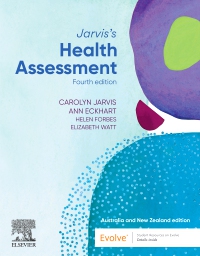

Jarvis's Health Assessment and Physical Examination - E-Book VBK, 4th Edition
Elsevier eBook on VitalSource
Now $59.49
The ideal student guide to assessing a person’s health
Jarvis’s Health Assessment provides the foundational knowledge and skills every nurse needs to assess people’s health.
Written by leading academics and clinicians, this text will help the learner seamlessly combine their knowledge of human anatomy and physiology with clinical assessment, communication and clinical reasoning skills. Its logical structure covers key theories, frameworks, techniques, specific areas of human function and how to apply health assessment knowledge and skills in practice.
The fourth edition has been fully updated for Australia and Aotearoa New Zealand and is relevant for each year of the undergraduate or pre-registration curriculum across multiple subjects. It is accompanied by a wealth of learning and teaching resources to help learners grasp both theoretical and practical concepts.
-
- Ideal for pre-registration course students, beginning and experienced registered nurses and those undertaking advanced practice roles
- Clearly separates knowledge and skills for nurses at a beginning level and those who have clinical experience, making it easy for teachers and students to identify content relevant to their level of learning
- Includes case studies to illustrate the initial parts of the clinical reasoning process and documentation of health assessments
- Easy to navigate, with a clear structure and colour-coding
- Extensive use of illustrations to clarify important anatomical and physiological concepts
- Accompanying resources include videos showcasing physical examination skills, PowerPoints and summative MCQ test banks
- A focus on person-centred care, health education, inclusive practice and lifespan
Instructor resources on Evolve
- PowerPoints
- Image collection
- Test banks
Student and instructor resources on Evolve
- Skills videos
-
UNIT 1 Approaches and contexts of health assessment in nursing
1. The context and frameworks of health assessment
2. Clinical decision making
3. Developmental tasks across the life span
4. Cultural safety
5. Screening for family violence
6. Screening for substance misuse
UNIT 2 Health assessment tools and techniques
7. Person-centred communication in health assessment
8. The health history
9. Physical examination techniques
10. General survey and vital signs
UNIT 3 Assessing mental health, neurological and sensory function
11. Mental health assessment
12. Neurological assessment
13. Pain assessment
14. Eye assessment
15. Ear assessment
UNIT 4 Assessing cardiovascular function
16. Peripheral vascular assessment
17. Cardiac assessment
UNIT 5 Assessing respiratory function
18. Upper airways assessment
19. Lower airways assessment
UNIT 6 Assessing musculoskeletal function
20. Musculoskeletal assessment
UNIT 7 Assessing nutrition and metabolic function
21. Nutritional and metabolic assessment
22. Skin, hair and nails assessment
UNIT 8 Urinary and bowel function
23. Abdominal assessment
24. Assessing urinary function
25. Assessing bowel function
UNIT 9 Assessing sexuality and reproductive function
26. Female sexual and reproductive assessment
27. Male sexual and reproductive assessment
28. Breasts assessment
29. Assessing pregnant women
UNIT 10 Using health assessment in clinical practice
30. Using health assessment to promote safe and quality nursing care -
-
Ways of Reading
- The appearance of the text and page layout can be modified according to the capabilities of the reading system (font family and font size, spaces between paragraphs, sentences, words, and letters, as well as color of background and text)
- This e-publication is accessible to the full extent that the file format and types of content allow, on a specific reading device, by default, without necessarily including any additions such as textual descriptions of images or enhanced navigation
- No information about nonvisual reading is available
-
Conformance
- No information is available
-
Navigation
- Table of contents to all chapters of the text via links
- Page list to go to pages from the print source version
-
Rich Content
- No information is available
-
Hazards
- No information is available
-
Product Content
- No information is available
-
Legal Considerations
- No information is available
-
Additional Accessibility Information
- Content is enhanced with ARIA roles to optimize organization and facilitate navigation
- Page breaks included from the original print source
- For readers with color vision deficiency, use of color (e.g., in diagrams, graphics and charts, in prompts, or on buttons inviting a response) is not the sole means of graphical distinction or of conveying information
- E-publication includes basic navigation (usually less detailed than TOC-based navigation)
- Where links, controls or buttons are included in the content, the purpose or functionality of each link, control or button is apparent from the associated text alone - or where it is unclear, separate link, control or button descriptions are provided
- All (or substantially all) textual matter is arranged in a single logical reading order (including text that is visually presented as separate from the main text flow, e.g., in boxouts, captions, tables, footnotes, endnotes, citations, etc.). Non-textual content is also linked from within this logical reading order. (Purely decorative non-text content can be ignored).
- The language of the text has been specified (e.g., via the HTML or XML lang attribute) to optimise text-to-speech (and other alternative renderings), both at the whole document level and, where appropriate, for individual words, phrases or passages in a different language.
-
Ways of Reading



 as described in our