ISBN:
9780729598613
Copyright:
2024
Publication Date:
11-12-2023
Page Count:
196
Imprint:
Elsevier
List Price:
$41.99

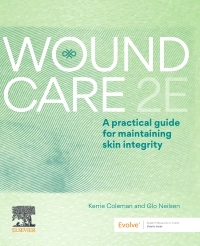
Wound Care - E-Book VBK, 2nd Edition
by Kerrie Coleman, MN Clinical (Wound), MNP (Chronic disease), BNsc, DipApSc PhD candidate and Glo Neilsen, RN, BHlth, MNLead, GCAP, PhD Candidate
Elsevier eBook on VitalSource
ISBN:
9780729598613
Copyright:
2024
Publication Date:
11-12-2023
Page Count:
196
Imprint:
Elsevier
List Price:
$41.99
$41.99
Or $0.00 with a valid access code
Not Yet Available
The second edition of Wound Care: a practical guide for maintaining skin integrity offers students and nurses a highly practical approach to treating acute and chronic wounds.
The book applies the latest evidence and theory to the real world, helping you develop skills and knowledge to manage wounds effectively. Each chapter provides an overview of specific wound types, followed by case studies to help you build your clinical reasoning skills, and related multiple choice questions to test your knowledge.
Editors Kerrie Coleman and Glo Neilsen have worked with a skilled team of clinical experts to completely refresh and update this edition, incorporating latest developments, tips, strategies and wound care products.
The book applies the latest evidence and theory to the real world, helping you develop skills and knowledge to manage wounds effectively. Each chapter provides an overview of specific wound types, followed by case studies to help you build your clinical reasoning skills, and related multiple choice questions to test your knowledge.
Editors Kerrie Coleman and Glo Neilsen have worked with a skilled team of clinical experts to completely refresh and update this edition, incorporating latest developments, tips, strategies and wound care products.
-
- Up-to-date and contemporary advice for Australia and New Zealand – ideal for students and nurses
- Packed full of evidence–based tips on wound care
- Focus on clinical reasoning, critical thinking and person–centred care
- Clearly presented information – concise and easy to navigate
- Case studies include an assessment and management approach to assist in developing effective clinical application of wound care theory
- Full colour photographs and illustrations to help you familiarise yourself with a variety of wound types
- A nursing focus with a multidisciplinary approach to help enhance the ‘real–world’ experience of wound care
- Answers to Case Study questions
- Image collection
- Self-assessment quizzes
- Quick reference list of local wound care products/dressings
-
-
 Evolve Resources for Wound CareResources
 -
 Wound CarePaperback
-
-
1. How to Improve the Wound Healing Process: Hints and Tips
2. Acute Wounds and How Best to Manage Them
3. Cellulitis Wounds
4. Malignant Wounds
5. Skin Integrity Issues
6. Australian First Nations People and Tropical Wounds
7. Individualising a Wound Management Plan
8. Dermatology Across the Lifespan
9. Wound Care on a Budget -
-
Ways of Reading
- The appearance of the text and page layout can be modified according to the capabilities of the reading system (font family and font size, spaces between paragraphs, sentences, words, and letters, as well as color of background and text)
- This e-publication is accessible to the full extent that the file format and types of content allow, on a specific reading device, by default, without necessarily including any additions such as textual descriptions of images or enhanced navigation
- No information about nonvisual reading is available
-
Conformance
- No information is available
-
Navigation
- Table of contents to all chapters of the text via links
- Page list to go to pages from the print source version
-
Rich Content
- No information is available
-
Hazards
- No information is available
-
Product Content
- No information is available
-
Legal Considerations
- No information is available
-
Additional Accessibility Information
- Content is enhanced with ARIA roles to optimize organization and facilitate navigation
- Page breaks included from the original print source
- For readers with color vision deficiency, use of color (e.g., in diagrams, graphics and charts, in prompts, or on buttons inviting a response) is not the sole means of graphical distinction or of conveying information
- E-publication includes basic navigation (usually less detailed than TOC-based navigation)
- Where links, controls or buttons are included in the content, the purpose or functionality of each link, control or button is apparent from the associated text alone - or where it is unclear, separate link, control or button descriptions are provided
- All (or substantially all) textual matter is arranged in a single logical reading order (including text that is visually presented as separate from the main text flow, e.g., in boxouts, captions, tables, footnotes, endnotes, citations, etc.). Non-textual content is also linked from within this logical reading order. (Purely decorative non-text content can be ignored).
- The language of the text has been specified (e.g., via the HTML or XML lang attribute) to optimise text-to-speech (and other alternative renderings), both at the whole document level and, where appropriate, for individual words, phrases or passages in a different language.
-
Ways of Reading
$41.99
Or $0.00 with a valid access code
Not Yet Available

 as described in our