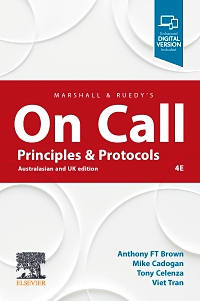

Marshall & Ruedy's On Call - E-Book VBK, 4th Edition
Elsevier eBook on VitalSource
Now $31.34
Marshall and Ruedy's On Call: Principles & Protocols, Australasian and UK 4th edition offers a carefully structured, risk-based approach to the initial assessment, investigation, differential diagnosis and short-term management of a wide variety of on-call ward problems.
This fourth edition has been completely revised, with the addition of a new author, new chapters and updated content based on the latest evidence-based guidelines. The layout is in a succinct, easy-to-read format that outlines a practical, fast, efficient and effective bedside approach to clinical problem-solving on call. Clinical reasoning has never been made so explicit and exciting!
-
- General principles: Overview of the professional, organisational, ethical and social traits required of the junior doctor on call
- Emergency calls: Risk-stratified approach to life-threatening airway, breathing, circulation, neurological disability and environment factors (ABCDE)
- Common calls: Explicit detail on how to deal with every call from urgent to non-life threatening, based on a standardised, reproducible clinical reasoning approach
- Investigations: How to interpret an ECG, common imaging, acid base, electrolyte and haematological tests when on call
- Practical procedures: How to perform a large array of practical procedures that may be needed when on call
- Formulary: Quick reference for the indications, actions, adverse effects, cautions, doses and routes of administration of the vast array of drugs encountered in ward patients
- Laboratory values: Normal values for all the common tests
- This edition includes the full eBook on eBooks+ with additional reading material, high-quality images, procedural videos and references
-
-
 Marshall & Ruedy’s On CallPaperback
-
-
Section A – General Principles
Approach to the diagnosis and management of on-call problems
Professionalism and teamwork
Documentation and communication
Ethical and legal considerations
Death, dying and breaking bad news
Transferring the unwell patient
Junior doctors’ health and wellbeing
Section B – Emergency Calls
Critically ill patient
Cardiac arrest
Acute airway failure
Acute respiratory failure
Acute circulatory failure
Disability: acute neurological failure
Environment, exposure and examination
Hospital-based emergency response codes
Section C – Common Calls
Shortness of breath, cough and haemoptysis
Chest pain
Heart rate and rhythm disorders
Hypotension
Hypertension
Altered mental status
Collapse including syncope
Falls
Headache
Seizures
Weakness and dizziness
Abdominal pain
Postoperative ward calls
Altered bowel habit
Gastrointestinal bleeding
Haematuria
Decreased urine output and acute kidney injury
Frequency and polyuria
Leg pain
Febrile patient
Skin rashes
Transfusion reactions
Section D – Investigations
Electrocardiogram
Urinalysis
Arterial and venous blood gases
Chest X-ray
Abdominal X-ray
CT head scan
Hyper- and hypoglycaemia
Hyper- and hyponatraemia
Hyper- and hypokalaemia
Hyper- and hypocalcaemia
Anaemia
Coagulation disorders
Section E – Practical Procedures
General preparation for a practical procedure
Infection control and standard precautions
Blood cultures
Peripheral venous cannulation
Basic ultrasound and difficult peripheral cannulation
Arterial puncture
Administering an injection
Local anaesthetic infiltration
Nasogastric tube insertion
Urinary catheterisation
Paracentesis
Pleural tap
Chest drain insertion and removal
Lumbar puncture
Joint aspiration
Cardiac monitoring and the electrocardiograph
Defibrillation
Electrical cardioversion (DC reversion)
Transthoracic cardiac pacing
Section F – Formulary
On-call formulary
Analgesics and local anaesthetics
Cardiovascular
Respiratory and allergy
Gastrointestinal
Neurological
Psychotropics
Antimicrobials
Endocrine and metabolic
Genitourinary
Antidotes
Section G – Laboratory Values
Normal laboratory ranges -
-
Ways of Reading
- The appearance of the text and page layout can be modified according to the capabilities of the reading system (font family and font size, spaces between paragraphs, sentences, words, and letters, as well as color of background and text)
- This e-publication is accessible to the full extent that the file format and types of content allow, on a specific reading device, by default, without necessarily including any additions such as textual descriptions of images or enhanced navigation
- No information about nonvisual reading is available
-
Conformance
- No information is available
-
Navigation
- Table of contents to all chapters of the text via links
- Page list to go to pages from the print source version
-
Rich Content
- No information is available
-
Hazards
- No information is available
-
Product Content
- No information is available
-
Legal Considerations
- No information is available
-
Additional Accessibility Information
- Content is enhanced with ARIA roles to optimize organization and facilitate navigation
- Page breaks included from the original print source
- For readers with color vision deficiency, use of color (e.g., in diagrams, graphics and charts, in prompts, or on buttons inviting a response) is not the sole means of graphical distinction or of conveying information
- E-publication includes basic navigation (usually less detailed than TOC-based navigation)
- Where links, controls or buttons are included in the content, the purpose or functionality of each link, control or button is apparent from the associated text alone - or where it is unclear, separate link, control or button descriptions are provided
- All (or substantially all) textual matter is arranged in a single logical reading order (including text that is visually presented as separate from the main text flow, e.g., in boxouts, captions, tables, footnotes, endnotes, citations, etc.). Non-textual content is also linked from within this logical reading order. (Purely decorative non-text content can be ignored).
- The language of the text has been specified (e.g., via the HTML or XML lang attribute) to optimise text-to-speech (and other alternative renderings), both at the whole document level and, where appropriate, for individual words, phrases or passages in a different language.
-
Ways of Reading

 as described in our