ISBN:
9781455726011
Copyright:
2013
Publication Date:
09-21-2012
Page Count:
888
Imprint:
Saunders
List Price:
$113.99

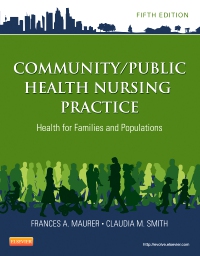
Community/Public Health Nursing Practice - Elsevier eBook on VitalSource, 5th Edition
by Frances A. Maurer, MS, RN-BC and Claudia M. Smith, PhD, MPH, RN-BC
Elsevier eBook on VitalSource
ISBN:
9781455726011
Copyright:
2013
Publication Date:
09-21-2012
Page Count:
888
Imprint:
Saunders
List Price:
$113.99
Was
$113.99
Now $102.59
Or $0.00 with a valid access code
Focusing on practical, need-to-know information, Community/Public Health Nursing Practice helps you learn how to apply the nursing process at the community and family level. It features an engaging, easy-to-understand writing style, as well as assessment tools, detailed case studies, and clinical examples that demonstrate how key concepts apply to real-world practice. Additional resources on the companion Evolve website expand and enhance content within the text.
-
- NEW! Healthy People 2020 objectives throughout the text help you identify common health risk factors in populations and families.
- NEW! Coverage of health care reform, including the Patient Protection and Affordable Care Act of 2010 (PPACA), explores how current health care legislation impacts community/public health nursing.
- NEW! Discussions of community health "hot button" issues, such as human trafficking, genital circumcision, and bullying, introduce you to today's health care challenges.
- NEW! Information on weather-related disaster fatalities, bioterrorism, and national and state planning responses familiarize you with current, relevant issues which affect the health of populations worldwide and shape the role of the community/public health nurse.
-
- Practical features including Case Studies, Ethics in Practice, and The Nursing Process in Practice illustrate real-world applications of key community/public health nursing concepts.
- A complete unit on the community as client helps you understand how the assessment, diagnosis, planning, intervention, and evaluation steps of the nursing process apply to the community, as opposed to an individual.
- A chapter devoted to community assessment provides a complete assessment tool and shows you how the tool applies to two different types of communities.
- UNIQUE! A chapter on screening and referral promotes population-focused practice, which is the crux of community/public health nursing.
- A separate unit on the family emphasizes the importance of viewing the family as a singular client.
- A complete discussion of the Minnesota Wheel helps you better understand this widely-accepted framework for community/public health nursing practice.
- Helpful sections such as Focus Questions, Chapter Outlines, Key Ideas, and Learning by Experience and Reflection help you pinpoint essential information.
-
Unit 1: Role and Context of Community/Public Health Nursing Practice
1. Responsibilities for Care in Community/Public Health Nursing
2. Origins and Future of Community/Public Health Nursing
3. The United States Health Care System
4. Financing of Health Care: Context for Community/Public Health Nursing
5. Global Health
6. Legal Context for Community/Public Health Nursing Practice
Unit 2: Core Concepts for the Practice of Community/Public Health Nursing
7. Epidemiology: Unraveling the Mysteries of Disease and Health
8. Communicable Diseases
9. Environmental Health Risks: At Home, at Work, and in the Community
10. Relevance of Culture and Values for Community/Public Health Nursing
Unit 3: Family as Client
11. Home Visit: Opening the Doors for Family Health
12. A Family Perspective in Community/Public Health Nursing
13. Family Case Management
14. Multiproblem Families
Unit 4: Community as Client
15. Community Assessment
16. Community Diagnosis, Planning, and Intervention
17. Evaluation of Nursing Care with Communities
Unit 5: Tools for Practice
18. Health Promotion and Risk Reduction in the Community
19. Screening and Referral
20. Health Teaching
Unit 6: Contemporary Problems in Community/Public Health Nursing
21. Vulnerable Populations
22. Disaster Management: Caring for Communities in an Emergency
23. Violence: A Social and Family Problem
24. Adolescent Sexual Activity and Teenage Pregnancy
25. Substance Use Disorders
Unit 7: Support for Special Populations
26. Rehabilitation Clients in the Community
27. Children in the Community
28. Elderly Persons in the Community
Unit 8: Settings for Community/Public Health Nursing Practice
29. State and Local Health Departments
30. School Health
31. Home Health Care
32. Rural Health
33. Community Mental Health -
-
Ways of Reading
- The appearance of the text and page layout can be modified according to the capabilities of the reading system (font family and font size, spaces between paragraphs, sentences, words, and letters, as well as color of background and text)
- This e-publication is accessible to the full extent that the file format and types of content allow, on a specific reading device, by default, without necessarily including any additions such as textual descriptions of images or enhanced navigation
- No information about nonvisual reading is available
-
Conformance
- No information is available
-
Navigation
- Table of contents to all chapters of the text via links
- Page list to go to pages from the print source version
-
Rich Content
- No information is available
-
Hazards
- No information is available
-
Product Content
- No information is available
-
Legal Considerations
- No information is available
-
Additional Accessibility Information
- Page breaks included from the original print source
- For readers with color vision deficiency, use of color (e.g., in diagrams, graphics and charts, in prompts, or on buttons inviting a response) is not the sole means of graphical distinction or of conveying information
- E-publication includes basic navigation (usually less detailed than TOC-based navigation)
- Where links, controls or buttons are included in the content, the purpose or functionality of each link, control or button is apparent from the associated text alone - or where it is unclear, separate link, control or button descriptions are provided
- All (or substantially all) textual matter is arranged in a single logical reading order (including text that is visually presented as separate from the main text flow, e.g., in boxouts, captions, tables, footnotes, endnotes, citations, etc.). Non-textual content is also linked from within this logical reading order. (Purely decorative non-text content can be ignored).
- The language of the text has been specified (e.g., via the HTML or XML lang attribute) to optimise text-to-speech (and other alternative renderings), both at the whole document level and, where appropriate, for individual words, phrases or passages in a different language.
-
Ways of Reading


Was
$113.99
Now $102.59
Or $0.00 with a valid access code

 as described in our