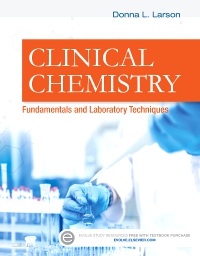

Clinical Chemistry - Elsevier eBook on VitalSource, 1st Edition
Elsevier eBook on VitalSource
Not only does Clinical Chemistry: Fundamentals and Laboratory Techniques provide a clear understanding of pathophysiology and lab testing, it provides complete clinical chemistry coverage for your two-year MLT program! It prepares students for success as medical lab technicians by simplifying complex chemistry concepts and lab techniques including immunoassays, molecular diagnostics, and quality control. Using a pathophysiologic approach, Larson covers diseases that are commonly diagnosed through chemical tests — broken down by body system and category — such as respiratory, gastrointestinal, and cardiovascular conditions. Ideal for students who may have minimal knowledge of chemistry, this full-color text includes complete resources to make teaching and learning easier.
-
- Full-color illustrations and design simplify complex concepts and make learning easier by highlighting important material.
- Case studies help students apply information to real-life scenarios.
- Pathophysiology and Analytes section includes information related to diseases or conditions, such as a biochemistry review, disease mechanisms, clinical correlation, and laboratory analytes and assays.
- Evolve companion website includes case studies and animations that reinforce material from the book.
- Laboratory Principles section covers safety, quality assurance, and other fundamentals of laboratory techniques.
- Other Aspects of Clinical Chemistry section covers therapeutic drug monitoring, toxicology, transplantation, and emergency preparedness.
- Critical thinking questions and discussion questions help students think about and apply key points and concepts.
- Learning objectives in each chapter help students to remember key points or to analyze and synthesize concepts in clinical chemistry.
- A list of key words Is provided at the beginning of each chapter, and these are also bolded in the text.
- Review questions at the end of each chapter are tied to the learning objectives, helping students review and retain the material.
- Chapter summaries consist of bulleted lists and tables highlighting the most important information.
- A glossary at the back of the book provides a quick reference to definitions of all clinical chemistry terms.
-
-
 Evolve Resources for Clinical ChemistryResources
 -
 Clinical ChemistryPaperback
-
-
Part I: Laboratory Principles
1. Laboratory Essentials
2. Laboratory Safety
3. Principles of Laboratory Instruments
4. Immunoassays
5. Molecular Diagnostics
6. Automation in the Laboratory
7. Quality Assurance and Quality Control in the Laboratory
8. Enzymes
Part II: Pathophysiology and Analytes
9. The Nature of Disease
10. Injury
11. Inflammation
12. Fluid Balance
13. Acid-Base
14. Blood Diseases
15. Proteins
16. Neoplasms and Tumor Markers
17. Blood Vessel Diseases
18. Heart Diseases
19. Respiratory Diseases
20. Gastrointestinal Diseases
21. Liver and Biliary Tract Diseases
22. Pancreatic Diseases
23. Endocrine Gland Diseases
24. Kidney Diseases
25. Reproductive System and Diseases
26. Pregnancy
27. Bones, Joints, and Skeletal Muscle Diseases
28. Nervous System Diseases
29. Skin, Hair, and Nail Diseases
30. Eye and Ear Diseases
31. Diseases of Daily Life and Diet
32. Immune System Diseases
Part III: Other Aspects of Clinical Chemistry
33. Therapeutic Drug Monitoring
34. Toxicology
35. Transplantation
36. Emergency Preparedness -
-
Ways of Reading
- The appearance of the text and page layout can be modified according to the capabilities of the reading system (font family and font size, spaces between paragraphs, sentences, words, and letters, as well as color of background and text)
- This e-publication is accessible to the full extent that the file format and types of content allow, on a specific reading device, by default, without necessarily including any additions such as textual descriptions of images or enhanced navigation
- No information about nonvisual reading is available
-
Conformance
- No information is available
-
Navigation
- Table of contents to all chapters of the text via links
- Page list to go to pages from the print source version
-
Rich Content
- No information is available
-
Hazards
- No information is available
-
Product Content
- No information is available
-
Legal Considerations
- No information is available
-
Additional Accessibility Information
- Page breaks included from the original print source
- For readers with color vision deficiency, use of color (e.g., in diagrams, graphics and charts, in prompts, or on buttons inviting a response) is not the sole means of graphical distinction or of conveying information
- E-publication includes basic navigation (usually less detailed than TOC-based navigation)
- Where links, controls or buttons are included in the content, the purpose or functionality of each link, control or button is apparent from the associated text alone - or where it is unclear, separate link, control or button descriptions are provided
- All (or substantially all) textual matter is arranged in a single logical reading order (including text that is visually presented as separate from the main text flow, e.g., in boxouts, captions, tables, footnotes, endnotes, citations, etc.). Non-textual content is also linked from within this logical reading order. (Purely decorative non-text content can be ignored).
- The language of the text has been specified (e.g., via the HTML or XML lang attribute) to optimise text-to-speech (and other alternative renderings), both at the whole document level and, where appropriate, for individual words, phrases or passages in a different language.
-
Ways of Reading

 as described in our