ISBN:
9781455757985
Copyright:
2011
Publication Date:
09-15-2010
Page Count:
544
Imprint:
Saunders
List Price:
$77.99

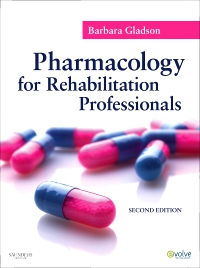
Pharmacology for Rehabilitation Professionals - Elsevier eBook on VitalSource, 2nd Edition
by Barbara Gladson, PhD, PT, OTR
Elsevier eBook on VitalSource
ISBN:
9781455757985
Copyright:
2011
Publication Date:
09-15-2010
Page Count:
544
Imprint:
Saunders
List Price:
$77.99
Most review copies are eBooks – how fast!
A review copy request is most likely to be fulfilled as an eBook on VitalSource rather than a print product, unless no eBook is available. eBooks become available in as little as a few hours. Print products will take between 7 and 10 days to arrive. To request a print copy, please contact us through the Evolve Support Center for further assistance or contact your Elsevier Sales Rep.
Fully revised and updated, this text remains your students' best resource for understanding how various drugs affect patients during therapeutic exercise and rehabilitation. Using case studies and engaging activities, it helps students apply essential pharmacology information directly to rehabilitation practice. New chapters, a new reader-friendly design, new artwork, and more enhance the text and bring readers up to date with both basic pharmacologic principles as well as the mechanism of action and side effects of drugs commonly seen in rehabilitation practice. A dynamic, interactive EVOLVE website provides additional resources for both you and your students.
-
- A new chapter on Complementary and Alternative Medicine in Pharmacology covers popular herbal and alternative products used to promote health, as well as herbal remedies used during menopause and in the treatment of cancer, helping you recognize the impact of herbals on your patients' symptoms and response to therapy.
- A new chapter on Drugs Affecting the Integumentary System discusses skin disorders and their pharmacological treatment, prophylactic and debriding agents, antiseptics, and more.
- A new chapter on Nutrition and Pharmacology provides current information on vitamins and minerals, enteral and parenteral nutrition, and food and drug interactions -- important topics that affect rehabilitation outcomes.
- Updated drug information and new drugs are added throughout the text, keeping you up to date with current pharmacological information as it pertains to rehabilitation.
-
- A new chapter on Complementary and Alternative Medicine in Pharmacology covers popular herbal and alternative products used to promote health, as well as herbal remedies used during menopause and in the treatment of cancer, helping students recognize the impact of herbals on patients' symptoms and response to therapy.
- A new chapter on Drugs Affecting the Integumentary System discusses skin disorders and their pharmacological treatment, prophylactic and debriding agents, antiseptics, and more.
- A new chapter on Nutrition and Pharmacology provides current information on vitamins and minerals, enteral and parenteral nutrition, and food and drug interactions -- important topics that affect rehabilitation outcomes.
- Updated drug information and new drugs are added throughout the text, keeping readers up to date with current pharmacological information as it pertains to rehabilitation.
-
Section One: Principles of Pharmacology
1. Introduction
2. Pharmacodynamics: Mechanisms of Action
3. Pharmacokinetics and Drug Dosing
4. Adverse Drug Reactions
Section Two: Autonomic and Cardiovascular Pharmacology
5. Drugs Acting on the Autonomic Nervous System
6. Antihypertensive Agents
7. Drug Therapy of Coronary Atherosclerosis and Its Repercussions
8. Drug Therapy for Congestive Heart Failure and Cardiac Arrhythmias
Section Three: Treatment for Pulmonary and Gastrointestinal Disorders
9. Drug Therapy for Pulmonary Disorders
10. Drugs for Gastrointestinal Disorders
Section Four: Pain Control
11. Anesthetic Agents
12. Drugs for the Treatment of Pain and Inflammation
13. Drug treatment for Arthritis Related Conditions
Section Five: Endocrine Pharmacology
14. Selective Topics in Endocrine Pharmacology
15. Drug Treatment for Osteoporosis and Diabetes
Section Six: Psychopharmacology
16. Drug Treatment for Depression and Anxiety
17. Drug Treatment for Schizophrenia and Bipolar Illness
Section Seven: Drugs Affecting the Nervous System
18. Drugs for Epilepsy and Attention Deficit/Hyperactivity Disorder
19. Antispasticity Medications and Skeletal Muscle Relaxants
20. Pharmacologic Management of Degenerative Neurologic Disorders
Section Eight: Drugs Affecting the Integumentary System
21. Integumentary System - NEW
Section Nine: Infectious Disease
22. Antimicrobial Agents
23. Antiviral Agents and Selected Drugs for Fungal Infections
Section Ten: Chemotherapeutic Drugs and Agents Acting on the Immune System
24. Chemotherapy and Immune Modulation
Section Eleven: The Relationship between Drug Therapy and Exercise
25. The Interaction between Selective Cardiopulmonary and Diabetic Medications and Exercise
Section Twelve: Special Topics
26. Nutrition and Pharmacology - NEW
27. Complementary and Alternative Medicine in Pharmacology - NEW -
-
Ways of Reading
- The appearance of the text and page layout can be modified according to the capabilities of the reading system (font family and font size, spaces between paragraphs, sentences, words, and letters, as well as color of background and text)
- This e-publication is accessible to the full extent that the file format and types of content allow, on a specific reading device, by default, without necessarily including any additions such as textual descriptions of images or enhanced navigation
- All content can be read as read aloud speech or dynamic braille
- Has alternative text descriptions for images
-
Conformance
- The publication contains a conformance statement that it meets the EPUB Accessibility 1.1, WCAG 2.1, Level AA standard. Please see https://bornaccessible.benetech.org/certified-publishers/ for further details of our compatibility testing.
- The certifier's credential is https://bornaccessible.benetech.org/certified-publishers/
- For detailed accessibility information, see Elsevier's website at https://www.elsevier.com/about/accessibility
- For queries regarding accessibility information, contact [email protected]
- The publication was certified on 07-04-2026
-
Navigation
- Table of contents to all chapters of the text via links
- Index with links to referenced entries
- Elements such as headings, tables, etc. for structured navigation
- Page list to go to pages from the print source version
-
Rich Content
- Information-rich images are described by extended descriptions
-
Hazards
- The publication contains no hazards
-
Product Content
- Content includes any type of illustrations.
- The primary content is text.
- Content includes a significant number of actionable (clickable) web links to external content, downloadable resources, supplementary material, etc.
- Content includes a significant number of actionable (clickable) cross-references, hyperlinked notes and annotations, or with other actionable links between largely textual elements (e.g., quiz/test questions, 'choose your own ending', etc.).
- Content includes figures, diagrams, charts and/or graphs, including other 'mechanical' (i.e. non-photographic) illustrations.
- Content includes a significant number of web links (printed URLs, QR codes etc.).
- Content includes text within images, including text-as-text embedded in diagrams, charts, or within images containing speech balloons, thought bubbles, captions, etc.
- Content includes mathematical notations, formulae.
-
Legal Considerations
- No information is available
-
Additional Accessibility Information
- Content is enhanced with ARIA roles to optimize organization and facilitate navigation
- Page breaks included from the original print source
- For readers with color vision deficiency, use of color (e.g., in diagrams, graphics and charts, in prompts, or on buttons inviting a response) is not the sole means of graphical distinction or of conveying information
- The body text is presented with a contrast ratio of at least 4.5:1 (or 3:1 for large/heading text)
- Ultra-high contrast between text and background
- E-publication includes basic navigation (usually less detailed than TOC-based navigation)
- Where links, controls or buttons are included in the content, the purpose or functionality of each link, control or button is apparent from the associated text alone - or where it is unclear, separate link, control or button descriptions are provided
- All (or substantially all) textual matter is arranged in a single logical reading order (including text that is visually presented as separate from the main text flow, e.g., in boxouts, captions, tables, footnotes, endnotes, citations, etc.). Non-textual content is also linked from within this logical reading order. (Purely decorative non-text content can be ignored).
- Where interactive content is included in the product, controls are provided (e.g., for speed, pause and resume, reset) and labelled to make their use clear.
- The language of the text has been specified (e.g., via the HTML or XML lang attribute) to optimise text-to-speech (and other alternative renderings), both at the whole document level and, where appropriate, for individual words, phrases or passages in a different language.
-
Ways of Reading


Most review copies are eBooks – how fast!
A review copy request is most likely to be fulfilled as an eBook on VitalSource rather than a print product, unless no eBook is available. eBooks become available in as little as a few hours. Print products will take between 7 and 10 days to arrive. To request a print copy, please contact us through the Evolve Support Center for further assistance or contact your Elsevier Sales Rep.

 as described in our