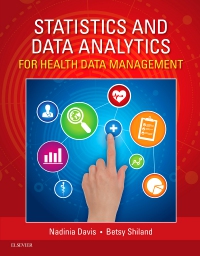

Statistics & Data Analytics for Health Data Management - Elsevier eBook on VitalSource, 1st Edition
Elsevier eBook on VitalSource
Now $54.89
Introducing Statistics & Data Analytics for Health Data Management by Nadinia Davis and Betsy Shiland, an engaging new text that emphasizes the easy-to-learn, practical use of statistics and manipulation of data in the health care setting. With its unique hands-on approach and friendly writing style, this vivid text uses real-world examples to show you how to identify the problem, find the right data, generate the statistics, and present the information to other users. Brief Case scenarios ask you to apply information to situations Health Information Management professionals encounter every day, and review questions are tied to learning objectives and Bloom’s taxonomy to reinforce core content. From planning budgets to explaining accounting methodologies, Statistics & Data Analytics addresses the key HIM Associate Degree-Entry Level competencies required by CAHIIM and covered in the RHIT exam.
-
- Meets key HIM Associate Degree-Entry Level competencies, as required by CAHIIM and covered on the RHIT registry exam, so you get the most accurate and timely content, plus in-depth knowledge of statistics as used on the job.
- Friendly, engaging writing style offers a student-centered approach to the often daunting subject of statistics.
- Four-color design with ample visuals makes this the only textbook of its kind to approach bland statistical concepts and unfamiliar health care settings with vivid illustrations and photos.
- Math review chapter brings you up-to-speed on the math skills you need to complete the text.
- Brief Case scenarios strengthen the text’s hands-on, practical approach by taking the information presented and asking you to apply it to situations HIM professionals encounter every day.
- Takeaway boxes highlight key points and important concepts.
- Math Review boxes remind you of basic arithmetic, often while providing additional practice.
- Stat Tip boxes explain trickier calculations, often with Excel formulas, and warn of pitfalls in tabulation.
- Review questions are tied to learning objectives and Bloom’s taxonomy to reinforce core content and let you check your understanding of all aspects of a topic.
- Integrated exercises give you time to pause, reflect, and retain what you have learned.
- Answers to integrated exercises, Brief Case scenarios, and review questions in the back of the book offer an opportunity for self-study.
- Appendix of commonly used formulas provides easy reference to every formula used in the textbook.
- A comprehensive glossary gives you one central location to look up the meaning of new terminology.
- Instructor resources include TEACH lesson plans, PowerPoint slides, classroom handouts, and a 500-question Test Bank in ExamView that help prepare instructors for classroom lectures.
-
Unit I: Understanding the Basics of Statistics and Data Analytics
1. Introduction to Statistical Terms and Concepts in Health Data Management
2. Basic Math Concepts, Central Tendency and Dispersion
3. Data Presentation
Unit II: Applications of Descriptive Statistics and Data Analysis in Health Care Settings
4. Administrative Data
5. Clinical Facility Data
6. Public Health Data
7. Departmental Data
8. Financial Data
Unit III: Advanced Data Analysis Techniques
9. Scrubbing and Mapping Data
10. Predicting Data -
-
Ways of Reading
- The appearance of the text and page layout can be modified according to the capabilities of the reading system (font family and font size, spaces between paragraphs, sentences, words, and letters, as well as color of background and text)
- This e-publication is accessible to the full extent that the file format and types of content allow, on a specific reading device, by default, without necessarily including any additions such as textual descriptions of images or enhanced navigation
- No information about nonvisual reading is available
-
Conformance
- No information is available
-
Navigation
- Table of contents to all chapters of the text via links
- Page list to go to pages from the print source version
-
Rich Content
- No information is available
-
Hazards
- No information is available
-
Product Content
- No information is available
-
Legal Considerations
- No information is available
-
Additional Accessibility Information
- Page breaks included from the original print source
- For readers with color vision deficiency, use of color (e.g., in diagrams, graphics and charts, in prompts, or on buttons inviting a response) is not the sole means of graphical distinction or of conveying information
- E-publication includes basic navigation (usually less detailed than TOC-based navigation)
- Where links, controls or buttons are included in the content, the purpose or functionality of each link, control or button is apparent from the associated text alone - or where it is unclear, separate link, control or button descriptions are provided
- All (or substantially all) textual matter is arranged in a single logical reading order (including text that is visually presented as separate from the main text flow, e.g., in boxouts, captions, tables, footnotes, endnotes, citations, etc.). Non-textual content is also linked from within this logical reading order. (Purely decorative non-text content can be ignored).
- The language of the text has been specified (e.g., via the HTML or XML lang attribute) to optimise text-to-speech (and other alternative renderings), both at the whole document level and, where appropriate, for individual words, phrases or passages in a different language.
-
Ways of Reading



 as described in our