
ISBN:
9788131269671
Copyright:
2024
Publication Date:
08-15-2024
Imprint:
Elsevier
List Price:
$0.00
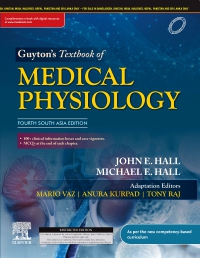
Guyton's Textbook of Medical Physiology, 4th South Asia Edition, 4th Edition
by Mario Vaz, MD, Anura Kurpad and Tony Raj
Paperback
ISBN:
9788131269671
Copyright:
2024
Publication Date:
08-15-2024
Imprint:
Elsevier
List Price:
$0.00
Not Yet Available
Most review copies are eBooks – how fast!
A review copy request is most likely to be fulfilled as an eBook on VitalSource rather than a print product, unless no eBook is available. eBooks become available in as little as a few hours. Print products will take between 7 and 10 days to arrive. To request a print copy, please contact us through the Evolve Support Center for further assistance or contact your Elsevier Sales Rep.
-
• Implementation of the one chapter-one lecture model, aligning the text with curriculum objectives to enhance appeal for students and faculty.
• Introduction of easy-to-read boxes containing clinical information, summaries, lists, and vignettes, providing accessible and relevant content.
???????• Incorporation of updated Learning Objectives and a Glossary of Terms at the beginning of every chapter, facilitating focused learning and understanding. • Addition of new multiple-choice questions (MCQs) for each chapter, promoting active learning and assessment opportunities. -
SECTION I General Physiology
1 Functional Organization of the Human Body and Control of the “Internal Environment”
2 The Cell and its Functions
3 Genetic Control of Protein Synthesis, Cell Function, and Cell Reproduction
4 Transport of Substances Through Cell Membranes
5 The Body Fluid Compartments
6 Intracellular and Extracellular Fluid Compartments and Edema
7 Resting Membrane Potential
SECTION II Nerve and Muscle Physiology
8 The Neuron: Stimulus and Excitability
9 Action Potential of the Nerve
10 Propagation of the Nerve Impulse
11 Peripheral Nerve Damage
12 Neuromuscular Transmission
13 Excitation–Contraction Coupling
14 Molecular Basis of Skeletal Muscle Contraction
15 Chemical Changes During Skeletal Muscle Contraction
16 Characteristics of Skeletal Muscle Contraction
17 Applied Skeletal Muscle Physiology
SECTION III Blood and Its Constituents
18 Introduction to Blood and Plasma Proteins
19 Red Blood Cells (Erythrocytes)
20 Erythropoiesis
21 Hemoglobin
22 Anemia and Polycythemia
23 Jaundice
24 White Blood Cells
25 Immunity and Allergy
26 Platelets
27 Blood Coagulation
28 Blood Groups
SECTION IV Cardiovascular Physiology
MARIO VAZ
29 Organization of the Cardiovascular System
30 Properties of Cardiac Muscle
31 Cardiac Action Potentials
32 Origin and Conduction of the Cardiac Impulse
33 The Normal Electrocardiogram
34 Clinical Applications of the Electrocardiogram
35 Cardiac Cycle
36 Cardiac Output and Venous Return
37 Regulation of Cardiac Output
38 Hemodynamics
39 Microcirculation
40 The Lymphatic System
41 The Venous System
42 Determinants of Arterial Blood Pressure
43 Short-Term Regulation of Arterial Blood Pressure
44 Long-Term Regulation of Arterial Blood Pressure
45 Local and Humoral Control of Blood Flow
46 Coronary Circulation
47 Cerebral Circulation
48 Splanchnic Circulation
49 Fetal and Neonatal Circulation
50 Valvular Heart Disease
51 Cardiac Failure
52 Circulatory Shock
SECTION V Respiratory Physiology
53 Organization of the Respiratory System
54 Mechanics of Breathing
55 Lung Volumes and Capacities
56 Ventilation
57 Pulmonary Circulation
58 Diffusion of Gases
59 Oxygen Transport
60 Carbon Dioxide Transport
61 Chemical Regulation of Respiration
62 Neural Regulation of Respiration
63 Respiration in Unusual Environments
64 Applied Respiratory Physiology
SECTION VI Gastrointestinal Physiology
65 Organization of the Gastrointestinal System
66 Salivary Glands and Secretion
67 Gastric Secretions
68 Exocrine Pancreas
69 Functions of the Liver
70 Digestion and Absorption of Carbohydrates
71 Digestion and Absorption of Proteins
72 Digestion and Absorption of Fats
73 Functions of the Small and Large Intestine
74 Gastrointestinal Motility
75 Physiology of Gastrointestinal Diseases
SECTION VII Renal Physiology
ANURA KURPAD
76 Functional Anatomy of the Kidney
77 Urine Formation by the Kidneys: Renal Blood Flow, Glomerular Filtration, and Their Control
78 Tubular Function
79 Concentration and Dilution of Urine
80 Control of Extracellular Fluid Osmolarity and Sodium Concentration
81 Renal Regulation of Potassium, Calcium, Phosphate, and Magnesium
82 Acid–Base Regulation
83 Micturition
84 Applied Physiology of the Renal System
SECTION VIII The Endocrine System
85 Organization of the Endocrine System
86 Hormone–Receptor Interactions
87 Anterior Pituitary Gland and Hypothalamus
88 Posterior Pituitary Gland
89 Thyroid Gland, Thymus and Pineal Gland
90 Calcium Homeostasis
91 Adrenal Cortex
92 Adrenal Medulla
93 Endocrine Pancreas and Glucose Homeostasis
SECTION IX Reproductive Physiology
94 Physiological Anatomy of the Male Sexual Organs and Spermatogenesis
95 Testosterone and Other Male Sex Hormones
96 Female Physiology Before Pregnancy and Female Hormones
97 The Sexual Act and Fertilization
98 Physiology of Pregnancy
99 Parturition and Lactation
SECTION X Central Nervous System
100 Organization of the Central Nervous System
PART I
Sensory System
101 Synapses
102 Sensory Receptors
103 Somatic Sensory Pathways
104 Pain and Temperature
105 Somatosensory Cortex
PART II
Special Senses
106 Taste and Smell
107 Hearing
108 Optics of Vision
109 The Retina
110 Visual Pathways and Central Processing
PART III
Motor System
111 Introduction to the Motor System: Spinal Cord
112 Cortical and Brainstem Control of Motor Function: The Pyramidal Tract
113 Muscle Spindle
114 Motor Reflexes
115 Regulation of Tone and Posture
116 Cerebellum
117 Vestibular Apparatus
118 Basal Ganglia
PART IV
Other Functions and Activities of the Brain
119 The Autonomic Nervous System
120 Functions of the Hypothalamus
121 Cerebrospinal Fluid
122 Electroencephalography, Epilepsy and Meditation
123 Sleep, Coma and Brain Death
124 The Limbic System and Behavior
125 Learning and Memory
126 Cortical Function, Cerebral Lateralization, and Speech
SECTION XI Integrative Physiology
127 Components of Energy Expenditure
128 Body Temperature Regulation and Cutaneous Circulation
129 Physiology of Starvation and Obesity
130 Physiology of Physical Activity and Inactivity
131 Physiological Responses to Exercise in Extreme Heat and Cold
132 Physiology of Stress
133 Transition from Fetus to Newborn, and Infancy
134 Physiological Changes with Aging
Index -
No accessibility information is available for this product.
Not Yet Available
Most review copies are eBooks – how fast!
A review copy request is most likely to be fulfilled as an eBook on VitalSource rather than a print product, unless no eBook is available. eBooks become available in as little as a few hours. Print products will take between 7 and 10 days to arrive. To request a print copy, please contact us through the Evolve Support Center for further assistance or contact your Elsevier Sales Rep.

 as described in our