ISBN:
9780323221986
Copyright:
2016
Publication Date:
05-26-2015
Page Count:
544
Imprint:
Mosby
List Price:
$72.99

The Muscle and Bone Palpation Manual with Trigger Points, Referral Patterns and Stretching - Elsevier eBook on VitalSource, 2nd Edition
by Joseph E. Muscolino, DC
Elsevier eBook on VitalSource
ISBN:
9780323221986
Copyright:
2016
Publication Date:
05-26-2015
Page Count:
544
Imprint:
Mosby
List Price:
$72.99
Most review copies are eBooks – how fast!
A review copy request is most likely to be fulfilled as an eBook on VitalSource rather than a print product, unless no eBook is available. eBooks become available in as little as a few hours. Print products will take between 7 and 10 days to arrive. To request a print copy, please contact us through the Evolve Support Center for further assistance or contact your Elsevier Sales Rep.
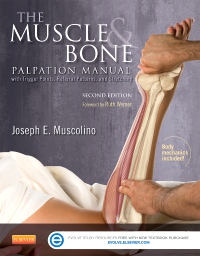
Muscolino’ s comprehensive and visually engaging coverage takes an in-depth look at palpation of muscle and bone along with trigger points and their pain referral patterns, stretching, specific muscle treatment, and more. Amazing four-color artwork shows palpation of the muscle with illustrations drawn over full-color photos. New additions such as review questions, "Deeper Thoughts," case studies and an Interactive Muscle Program help your students develop integrative clinical-reasoning skills and successfully apply palpation techniques in massage therapy.
New Edition Expected Availability: 05-12-2022

The Muscle and Bone Palpation Manual with Trigger Points, Referral Patterns and Stretching Elsevier eBook on VitalSource
Elsevier eBook on VitalSource
ISBN: 9780323761383
-
- NEW! Interactive Muscle Program available on Evolve allows you to see muscle attachments and the relationship among the muscles of the region, easing the process and aiding in retention of material.
- NEW! Drawings of therapist-assisted stretches added to the third section of the text supplies you with a comprehensive look at stretching, with both the existing self-stretches and the assisted stretches presented side-by-side.
- NEW! Case studies keep your interest level high with the opportunity for integrative, clinical reasoning.
- NEW! Reformatted Bone Palpation and Ligaments section offers content in a narrative format consistent with the rest of the text for easier navigation.
- NEW! "Deeper Thoughts" questions actively engage and challenge your reasoning skills.
- NEW! Review questions allow you to discuss concepts and synthesize important chapter information.
-
- NEW! Unique Interactive Muscle Program available on Evolve allows students to see muscle attachments and the relationship among the muscles of the region, easing the process and aiding in retention of material.
- Amazing four-color artwork shows palpation of the muscle with muscle and bone illustrations drawn over full-color photos offering students a better sense of exactly how the muscles look and where the muscle is located underneath the skin as it is being palpated.
- NEW! Drawings of therapist-assisted stretches added to the third section of the text supplies students with a comprehensive look at stretching, with both the existing self-stretches and the assisted stretches presented side-by-side.
- NEW! Case studies keep students’ interest level high with the opportunity for integrative, clinical reasoning.
- Step-by-step muscle palpitation coverage with clear reasoning provided for each step presents content in a way that is easily understood and remembered rather than just memorized.
- Bone Palpation coverage teaches students to identify and palpate bones and bony landmarks.
- Specific massage-related assessment and treatment strokes are shown through illustrations and in the Palpation Notes moving students from theory and assessment to practical application.
- UNIQUE! Palpation photos help students and therapists learn to identify muscles when the body is positioned the way they will encounter it in the massage setting.
- NEW! "Deeper Thoughts" questions actively engage students and challenge their reasoning skills.
- NEW! Review questions allow students to discuss concepts and synthesize important chapter information.
- UNIQUE! Stretching coverage provides more information on this effective treatment technique and helps students understand the role of stretching in treatment.
- Trigger Points and Referral Patterns illustrations show where trigger points lie on the muscle and where pain radiates when an injury is felt so students can effectively identify trigger points and referral patterns in a clinical setting.
- NEW! Reformatted Bone Palpation and Ligaments section offers content in a narrative format consistent with the rest of the text for easier navigation.
- Measurable chapter objectives at the start of each chapter identify key goals for students as well as information that should be mastered.
- Chapter overviews and outlines introduce each chapter so students can preview the content and direction of the chapter at the major concept level.
-
PART I: ASSESSMENT AND TREATMENT TECHNIQUES
1. Introduction to Palpation
2. The Art and Science of Muscle Palpation
3. Draping and Basic Massage Strokes
4. Body Mechanics for the Manual Therapist
5. Anatomy, Physiology, and Treatment of Trigger Points
6. Stretching
PART 2: BONE PALPATION AND LIGAMENTS
7. Upper Extremity Bone Palpation and Ligaments
8. Axial Body Bone Palpation and Ligaments
9. Lower Extremity Bone Palpation and Ligaments
PART 3: MUSCLE PALPATION
10. Tour #1: Palpation of the Muscles of the Shoulder Girdle
11. Tour #2: Palpation of the Neck Muscles
12. Tour #3: Palpation of the Muscles of the Head
13. Tour #4: Palpation of the Muscles of the Arm
14. Tour #5: Palpation of the Muscles of the Forearm
15. Tour #6: Palpation of the Intrinsic Muscles of the Hand
16. Tour #7: Palpation of the Trunk Muscles
17. Tour #8: Palpation of the Pelvic Muscles
18. Tour #9: Palpation of the Thigh Muscles
19. Tour #10: Palpation of the Leg Muscles
20. Tour #11: Palpation of the Intrinsic Muscles of the Foot -
-
Ways of Reading
- The appearance of the text and page layout can be modified according to the capabilities of the reading system (font family and font size, spaces between paragraphs, sentences, words, and letters, as well as color of background and text)
- This e-publication is accessible to the full extent that the file format and types of content allow, on a specific reading device, by default, without necessarily including any additions such as textual descriptions of images or enhanced navigation
- No information about nonvisual reading is available
-
Conformance
- The publication was certified on 27-05-2026
-
Navigation
- Table of contents to all chapters of the text via links
- Page list to go to pages from the print source version
-
Rich Content
- No information is available
-
Hazards
- No information is available
-
Product Content
- No information is available
-
Legal Considerations
- No information is available
-
Additional Accessibility Information
- Page breaks included from the original print source
- For readers with color vision deficiency, use of color (e.g., in diagrams, graphics and charts, in prompts, or on buttons inviting a response) is not the sole means of graphical distinction or of conveying information
- E-publication includes basic navigation (usually less detailed than TOC-based navigation)
- Where links, controls or buttons are included in the content, the purpose or functionality of each link, control or button is apparent from the associated text alone - or where it is unclear, separate link, control or button descriptions are provided
- All (or substantially all) textual matter is arranged in a single logical reading order (including text that is visually presented as separate from the main text flow, e.g., in boxouts, captions, tables, footnotes, endnotes, citations, etc.). Non-textual content is also linked from within this logical reading order. (Purely decorative non-text content can be ignored).
- The language of the text has been specified (e.g., via the HTML or XML lang attribute) to optimise text-to-speech (and other alternative renderings), both at the whole document level and, where appropriate, for individual words, phrases or passages in a different language.
-
Ways of Reading
Most review copies are eBooks – how fast!
A review copy request is most likely to be fulfilled as an eBook on VitalSource rather than a print product, unless no eBook is available. eBooks become available in as little as a few hours. Print products will take between 7 and 10 days to arrive. To request a print copy, please contact us through the Evolve Support Center for further assistance or contact your Elsevier Sales Rep.

 as described in our