ISBN:
9780323655552
Copyright:
2021
Publication Date:
10-16-2020
Page Count:
520
Imprint:
Saunders
List Price:
$117.99

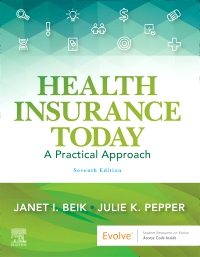
Health Insurance Today - Elsevier eBook on VitalSource, 7th Edition
by Janet I. Beik, AA, BA, MEd and Julie Pepper, BS, CMA (AAMA)
Elsevier eBook on VitalSource
ISBN:
9780323655552
Copyright:
2021
Publication Date:
10-16-2020
Page Count:
520
Imprint:
Saunders
List Price:
$117.99
Most review copies are eBooks – how fast!
A review copy request is most likely to be fulfilled as an eBook on VitalSource rather than a print product, unless no eBook is available. eBooks become available in as little as a few hours. Print products will take between 7 and 10 days to arrive. To request a print copy, please contact us through the Evolve Support Center for further assistance or contact your Elsevier Sales Rep.
Help your students master the complexities of health insurance with this easy-to-understand guide! Health Insurance Today: A Practical Approach, 7th Edition provides a solid foundation in basics such as the types and sources of health insurance, the submission of claims, and the ethical and legal issues surrounding insurance. It follows the claims process from billing and coding to reimbursement procedures, with realistic practice on the Evolve website. This edition adds coverage of the latest advances and issues in health insurance, including EHRs, Medicare, and other types of carriers. Making difficult concepts seem anything but difficult, this resource prepares students for successful careers as health insurance professionals.
New Edition Expected Availability: 12-19-2023

Beik's Health Insurance Today - Elsevier EBook on VitalSource
Elsevier eBook on VitalSource
ISBN: 9780323934114
-
- NEW and UNIQUE! Patient’s Point of View boxes enable you to imagine yourself on the other side of the desk
- NEW and UNIQUE! Opening and closing chapter scenarios present on-the-job challenges that must be resolved using critical thinking skills
- NEW! End-of-chapter review questions ensure that you can understand and apply the material
- NEW! Clear explanations show how electronic technology is used in patient verification, electronic claims, and claims follow-up
- NEW! Coverage of the Affordable Care Act introduces new and innovative ways that modifications to the ACA allow people to acquire healthcare coverage
- NEW! Updated information addresses all health insurance topics, including key topics like Medicare and Electronic Health Records
- NEW! More emphasis on electronic claims submission has been added
- NEW! Updated figures, graphs, and tables summarize the latest health insurance information
-
- NEW and UNIQUE! Patient’s Point of View boxes enable students to imagine themselves on the other side of the desk
- NEW and UNIQUE! Opening and closing chapter scenarios present on-the-job challenges that must be resolved using critical thinking skills
- NEW! End-of-chapter review questions ensure that students can understand and apply the material
- NEW! Clear explanations show how electronic technology is used in patient verification, electronic claims, and claims follow-up
- NEW! Coverage of the Affordable Care Act introduces new and innovative ways that modifications to the ACA allow people to acquire healthcare coverage
- NEW! Updated information addresses all health insurance issues, including key topics like Medicare and Electronic Health Records
- NEW! More emphasis on electronic claims submission has been added
- NEW! Updated figures, graphs, and tables summarize the latest health insurance information
- NEW! Consolidation of selected chapters provides a more concise presentation of the material
- What Did You Learn? review questions, Imagine This! scenarios, and Stop and Think exercises ensure that students understand the material, can apply it to real-life situations, and develop critical thinking skills
- Clear, attainable learning objectives highlight the most important information in each chapter
- CMS-1500 software with case studies on the Evolve companion website gives students hands-on practice with filling in a CMS-1500 form electronically
- UNIQUE! UB-04 software with case studies on Evolve gives students hands-on practice with filling in UB-04 forms electronically
- UNIQUE! SimChart® for the Medical Office (SCMO) cases on Evolve give students real-world practice in an EHR environment
- HIPAA Tips emphasize the importance of privacy and of following government rules and regulations
- Direct, conversational writing style makes it easier for students to learn and remember the material
- End-of-chapter summaries relate to the chapter-opening learning objectives, provide a thorough review of key content, and allow students to quickly find information for further review
- Chapter review questions on Evolve help students assess their comprehension of key concepts
-
-
 Workbook for Health Insurance Today Elsevier eBook on VitalSourceElsevier eBook on VitalSource
 -

-
 Medical Insurance Online for Health Insurance TodayOnline Course
-
-
Unit 1: Building a Foundation
1. The Origins of Health Insurance
2. Tools of the Trade: A Career as a Health (Medical) Insurance Professional
3. The Legal and Ethical Side of Medical Insurance
4. Types and Sources of Health Insurance
Unit 2: Health Insurance Basics
5. Claim Submission Methods
6. Traditional Fee-for-Service/Private Plans
7. Unraveling the Mysteries of Managed Care
8. Understanding Medicaid
9. Conquering Medicare’s Challenges
10. Military Carriers
11. Miscellaneous Carriers: Workers’ Compensation and Disability Insurance
Unit 3: Cracking the Codes
12. Diagnostic Coding
13. Procedural, Evaluation and Management, and HCPCS Coding
Unit 4: The Claims Process
14. The Patient
15. Keys to Successful Claims Management
Unit 5: Advanced Application
16. The Role of Computers in Health Insurance
17. Reimbursement Procedures: Getting Paid
18. Hospital Billing and the UB-04 -
-
Ways of Reading
- The appearance of the text and page layout can be modified according to the capabilities of the reading system (font family and font size, spaces between paragraphs, sentences, words, and letters, as well as color of background and text)
- This e-publication is accessible to the full extent that the file format and types of content allow, on a specific reading device, by default, without necessarily including any additions such as textual descriptions of images or enhanced navigation
- No information about nonvisual reading is available
-
Conformance
- No information is available
-
Navigation
- Table of contents to all chapters of the text via links
- Page list to go to pages from the print source version
-
Rich Content
- No information is available
-
Hazards
- No information is available
-
Product Content
- No information is available
-
Legal Considerations
- No information is available
-
Additional Accessibility Information
- Page breaks included from the original print source
- For readers with color vision deficiency, use of color (e.g., in diagrams, graphics and charts, in prompts, or on buttons inviting a response) is not the sole means of graphical distinction or of conveying information
- E-publication includes basic navigation (usually less detailed than TOC-based navigation)
- Where links, controls or buttons are included in the content, the purpose or functionality of each link, control or button is apparent from the associated text alone - or where it is unclear, separate link, control or button descriptions are provided
- All (or substantially all) textual matter is arranged in a single logical reading order (including text that is visually presented as separate from the main text flow, e.g., in boxouts, captions, tables, footnotes, endnotes, citations, etc.). Non-textual content is also linked from within this logical reading order. (Purely decorative non-text content can be ignored).
- The language of the text has been specified (e.g., via the HTML or XML lang attribute) to optimise text-to-speech (and other alternative renderings), both at the whole document level and, where appropriate, for individual words, phrases or passages in a different language.
-
Ways of Reading
Most review copies are eBooks – how fast!
A review copy request is most likely to be fulfilled as an eBook on VitalSource rather than a print product, unless no eBook is available. eBooks become available in as little as a few hours. Print products will take between 7 and 10 days to arrive. To request a print copy, please contact us through the Evolve Support Center for further assistance or contact your Elsevier Sales Rep.

 as described in our