ISBN:
9780323876407
Copyright:
2024
Publication Date:
01-17-2023
Page Count:
448
Imprint:
Elsevier
List Price:
$65.99

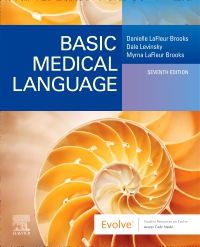
Basic Medical Language with Flash Cards, Elsevier EBook on VitalSource, 7th Edition
by Danielle LaFleur Brooks, MEd, MA, Myrna LaFleur Brooks, RN, BEd and Dale M. Levinsky, MD
Elsevier eBook on VitalSource
ISBN:
9780323876407
Copyright:
2024
Publication Date:
01-17-2023
Page Count:
448
Imprint:
Elsevier
List Price:
$65.99
Most review copies are eBooks – how fast!
A review copy request is most likely to be fulfilled as an eBook on VitalSource rather than a print product, unless no eBook is available. eBooks become available in as little as a few hours. Print products will take between 7 and 10 days to arrive. To request a print copy, please contact us through the Evolve Support Center for further assistance or contact your Elsevier Sales Rep.
Give students the foundation they need to confidently communicate with the healthcare team! Basic Medical Language, 7th Edition makes it easier to master the medical terminology needed for success in the health professions. This concise text helps students learn and recognize hundreds of medical terms by introducing the suffixes, prefixes, and combining forms used in building words. Brief, illustrated lessons present terms by body system, and include exercises that ask students to build, define, and read commonly used medical terms. Along with realistic case studies, this book includes an Evolve website that simplifies learning with animations, activities, games, quizzes, and more.
New Edition Expected Availability: 02-01-2027

Basic Medical Language with Flash Cards - Elsevier eBook on VitalSource
Elsevier eBook on VitalSource
ISBN: 9780443350368
-
- NEW! Introduction to Diagnostic Imaging discusses radiology and features medical terms used in clinical practice.
- NEW! Laboratory Medical Terms provide insight into laboratory tests, collection techniques, and sections of clinical laboratories.
- NEW! Expanded quizzes with additional practical application questions conclude each lesson.
-
- NEW! Introduction to Diagnostic Imaging discusses radiology and features medical terms used in clinical practice.
- NEW! Addition of Laboratory Medical Terms provides insight into laboratory tests, collection techniques, and sections of clinical laboratories.
- NEW! Expanded content quizzes with additional practical application questions conclude each lesson.
- NEW! Two additional medical records provide another way to interpret medical language used in context.
- NEW! Online Gradable Exercises and Practice Exams can be integrated with gradebooks for most learning platforms.
- Case studies open each lesson and correlate with a medical record where students apply what they have learned by writing medical terms within the document.
- Career Focus sections highlight professional roles connected with lesson content to inspire students as they consider employment opportunities.
- Interactive illustrations encourage students to make visual connections and uncover medical concepts as they label figures with medical terms.
- Online Electronic Health Record modules, consisting of three related medical records for one patient account, familiarize students with the EHRs they will encounter in practice.
- More than 200 flashcards are packaged free with the text and available online with Evolve student resources, making it easier for students to memorize word parts and abbreviations.
- Engaging exercises test student knowledge with matching, building, and reading medical terms in context, helping students to learn medical terms built from word parts as well as those NOT built from word parts.
- Emphasis on frequently used medical terms includes words and abbreviations used in clinical settings, billing, and coding.
- Systemic presentation of medical terms helps students learn and recognize new words by body system and clinical category.
- Word part tables introduce combining forms, suffixes, and prefixes and Lesson at a Glance briefly summarizes testable content.
- Objectives integrated with lesson headings directly correlate objectives with content, including exercises, quizzes, and exams, along with instructor resources including lesson plans, slides, and handouts.
- Student resources on the Evolve website include games, learning activities, quizzes, videos, and an audio glossary ― all tied closely to material in the text.
-
-

-
 Basic Medical Language with Flash CardsPaperback
-
-
1. Introduction to Medical Language, Body Structure, Oncology, and Laboratory Tests
2. Directional Terms, Positions, and Imaging
3. Integumentary System, Colors, and Plural Endings
4. Respiratory System
5. Urinary System
6. Reproductive Systems
7. Cardiovascular and Lymphatic Systems
8. Digestive System
9. Eye and Ear
10. Musculoskeletal System
11. Nervous System and Behavioral Health
12. Endocrine System
APPENDIX
A. Word Parts Used in Basic Medical Language
B. Abbreviations & Error-Prone List
C. Answer Key
Illustration Credits
Index
Evolve Appendices, Evolve Resources at evolve.elsevier.com
D. Pharmacology Terms
E. Health Information Technology Terms
F. Integrative Medicine Terms -
-
Ways of Reading
- The appearance of the text and page layout can be modified according to the capabilities of the reading system (font family and font size, spaces between paragraphs, sentences, words, and letters, as well as color of background and text)
- This e-publication is accessible to the full extent that the file format and types of content allow, on a specific reading device, by default, without necessarily including any additions such as textual descriptions of images or enhanced navigation
- No information about nonvisual reading is available
-
Conformance
- For detailed accessibility information, see Elsevier's website at https://www.elsevier.com/about/accessibility
- For queries regarding accessibility information, contact [email protected]
- The publication was certified on 03-11-2025
-
Navigation
- Table of contents to all chapters of the text via links
-
Rich Content
- No information is available
-
Hazards
- No information is available
-
Product Content
- No information is available
-
Legal Considerations
- No information is available
-
Additional Accessibility Information
- For readers with color vision deficiency, use of color (e.g., in diagrams, graphics and charts, in prompts, or on buttons inviting a response) is not the sole means of graphical distinction or of conveying information
- E-publication includes basic navigation (usually less detailed than TOC-based navigation)
- Where links, controls or buttons are included in the content, the purpose or functionality of each link, control or button is apparent from the associated text alone - or where it is unclear, separate link, control or button descriptions are provided
- All (or substantially all) textual matter is arranged in a single logical reading order (including text that is visually presented as separate from the main text flow, e.g., in boxouts, captions, tables, footnotes, endnotes, citations, etc.). Non-textual content is also linked from within this logical reading order. (Purely decorative non-text content can be ignored).
- The language of the text has been specified (e.g., via the HTML or XML lang attribute) to optimise text-to-speech (and other alternative renderings), both at the whole document level and, where appropriate, for individual words, phrases or passages in a different language.
-
Ways of Reading
Most review copies are eBooks – how fast!
A review copy request is most likely to be fulfilled as an eBook on VitalSource rather than a print product, unless no eBook is available. eBooks become available in as little as a few hours. Print products will take between 7 and 10 days to arrive. To request a print copy, please contact us through the Evolve Support Center for further assistance or contact your Elsevier Sales Rep.

 as described in our