ISBN:
9780443107368
Copyright:
2025
Publication Date:
09-13-2024
Page Count:
318
Imprint:
Elsevier
List Price:
$70.99
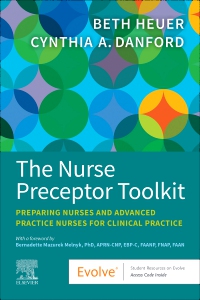
The Nurse Preceptor Toolkit, 1st Edition
by Beth Heuer, DNP, APRN-CNP, CPNP-PC, PMHS, FAANP and Cynthia A. Danford, PhD, CRNP, PPCNP-BC, CPNP-PC, FAAN
Paperback
ISBN:
9780443107368
Copyright:
2025
Publication Date:
09-13-2024
Page Count:
318
Imprint:
Elsevier
List Price:
$70.99
In Stock
Most review copies are eBooks – how fast!
A review copy request is most likely to be fulfilled as an eBook on VitalSource rather than a print product, unless no eBook is available. eBooks become available in as little as a few hours. Print products will take between 7 and 10 days to arrive. To request a print copy, please contact us through the Evolve Support Center for further assistance or contact your Elsevier Sales Rep.
Equip faculty and clinicians to develop the skills necessary for precepting RN and APRN students and new orientees! The Nurse Preceptor Toolkit is written by and for RN and APRN clinicians and faculty members from a variety of levels, specialties, and settings. Using real-life examples and practical tips, this comprehensive resource answers the questions preceptors often ask when interacting with students of all levels, as well as new orientees. Within its pages, your faculty and preceptors will find everything they need to develop and solidify the clinical teaching skills essential to becoming effective preceptors.
-
- This completely new book serves as a comprehensive resource for precepting both RN and APRN students and new orientees.
- Coverage addresses questions preceptors have asked when interacting with students of all levels, as well as with new orientees.
- Content is written by and for RN and APRN clinicians and faculty members from a variety of levels, specialties, and settings.
- Real-life examples and practical tips guide the development and solidification of the clinical teaching skills needed to become an effective preceptor.
- Coverage of essential precepting topics includes effective communication, flexibility, time management skills, providing feedback and support, an understanding of different adult learning styles, and the ability to confidently evaluate student knowledge and competencies.
- Chapter objectives serve as “advance organizers” to help prepare budding clinical preceptors for the content that follows.
- Exemplars model excellence in clinical precepting through contributor-authored stories of successful faculty-preceptor-learner partnerships related to the content of each chapter.
- Boxes highlight tips from successful preceptors.
- Appendices provide ready-to-use tools to enhance the preceptor-learner experience.
-
-

-
 The Nurse Preceptor Toolkit - Elsevier E-Book on VitalSourceElsevier eBook on VitalSource
-
-
PART I Setting the Stage
1. Introduction to Precepting
PART II Defining the Preceptor
2. Starting With the Basics
3. Why Precept?
4. Coaching and Mentoring
PART III Framing the Precepting Experience
5. Understanding the Learner and the Learning Process
6. Fostering Effective Preceptor-Learner Communication
7. The Learning Curve: A Parallel Venture for Preceptors and Learners
PART IV Clinical Judgment Skills and Precepting Models
8. Special Precepting Tools for Clinical Judgment
PART V Tools for Precepting
9. Expectations: Preceptors, Faculty, and Academic Programs
10. Providing a Well-Rounded Clinical Experience
11. Special Considerations When Precepting Nurse Practitioner Students
12. Precepting the Undergraduate and Graduate-Entry Nursing Student
13. Onboarding the New Nurse
14. Orienting the Advanced Practice Registered Nurse Student
15. Guiding the Nurse Practitioner Student Experience
16. Professional Development for the Preceptor and the Orientee
17. Managing Challenging Behaviors With Learners in Clinical Environments
18. Self-Care for the Busy Preceptor
19. Managing Barriers in the APRN Clinical Site
20. Documentation
21. Evaluation
22. Moving Into Leadership Roles Beyond Practice
23. Precepting in Global Health Experiences
24. Precepting in Specialty Settings
25. Bringing Closure to the Precepting Experience -
No accessibility information is available for this product.
In Stock
Most review copies are eBooks – how fast!
A review copy request is most likely to be fulfilled as an eBook on VitalSource rather than a print product, unless no eBook is available. eBooks become available in as little as a few hours. Print products will take between 7 and 10 days to arrive. To request a print copy, please contact us through the Evolve Support Center for further assistance or contact your Elsevier Sales Rep.

 as described in our