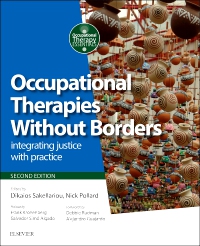

Occupational Therapies Without Borders - Elsevier eBook on VitalSource, 2nd Edition
Elsevier eBook on VitalSource
Centering on the wider social and political aspects of occupation and occupation-based practices, this textbook aims to inspire occupational therapy students and practitioners to include transformational elements into their practice. It also illustrates how occupational therapists from all over the world can affect positive changes by engaging with political and historical contexts.
Divided into six sections, the new edition begins by analyzing the key concepts outlined throughout, along with an overview on the importance and practicalities of monitoring and evaluation in community projects. Section Two explores occupation and justice emphasizing that issues of occupational injustice are present everywhere, in different forms: from clinical settings to community-based rehabilitation. Section Three covers the enactment of different Occupational Therapies with a focus on the multiplicity of occupational therapy from the intimately personal to the broadly political. Section Four engages with the broader context of occupational therapy from the political to the financial. The chapters in this section highlight the recent financial crisis and the impact it has had on people’s everyday life. Section Five collects a range of different approaches to working to enable a notion of occupational justice. Featuring chapters from across the globe, Section Six concludes by highlighting the importance and diversity of educational practices.
New Edition Expected Availability: 06-30-2026

Occupational Therapies Without Borders - Elsevier eBook on VitalSource
-
- Comprehensively covers occupational therapy theory, methodology and practice examples related to working with underserved and neglected populations
- Gives a truly global overview with contributions from over 100 international leading experts in the field and across a range of geographical, political and linguistic contexts
- Demonstrates how occupational injustices are shaped through political, economic and historical factors
- Advocates participatory approaches which work for those who experience inequalities
-
1. Introduction
SECTION 1: KEY CONCEPTS IN THIS BOOK
2. Occupational Justice: A Fine Balance For Occupational Therapists
3. Exploring Occupation Beyond The Individual: Family And Collective Occupation
4. Conceptualizing Disability
5. The Impact Of Neoliberalism On Health And The Health System: The Case Of Chile
6. Austerity And The Rise Of Hostility Towards Marginalized Groups
7. Are We Really Making A Difference? Monitoring And Evaluation In Community Based Practice
8. Designing Participatory Action Research To Relocate Margins, Borders And Centres
SECTION 2: EXPLORING OCCUPATION AND JUSTICE
9. Occupational Justice In Everyday Occupational Therapy Practice
10. Owning Occupational Therapy Theories And Concepts: Wearing Your Own Coat!
11. Human Rights, Occupational Therapy And The Centrality Of Social Practices
12. Appreciating The Lived Experience Of Some Older Gay People: Considerations For Contemporary Occupational Therapy Practice
13. Broadening Understandings Of Occupational Identity: Illustrations From A Research Study Of Homeless Adults
14. Leisure As A Route To Social And Occupational Justice For Individuals With Profound Levels Of Disability
15. In Our Own Hands And In The Eyes Of Others: The Emancipatory Imperative Of Occupational Witnessing For Belonging And Becoming
16. Return To Work Support For Breast Cancer Survivors: A Recently Qualified Occupational Therapist’s Journey Into Research
17. Systematic Mapping Review Of Notions Of Justice In Occupational Therapy
18. The Participatory Occupational Justice Framework: Salience Across Contexts
19. Cultivating A Human Rights Culture For Occupational Therapy
SECTION 3: THE ENACTMENT OF DIFFERENT OCCUPATIONAL THERAPIES
20. Occupational Therapy In A Glocalized World
21. Our Professional Existence Is Political: Critical Reflections On ‘Seeing White’ In Occupational Therapy
22. Occupational Therapy Across South America: An Overview Of Its Backgrounds, Current Situation And Some Contemporary Issues
23. Investigating Occupational Therapy: From Disability Studies To Ability Studies
24. Living And Working As An Underground Occupational Therapist/Scientist In Los Angeles
25. Occupational Science Informing Practice For Occupational Justice
26. Enabling Occupational Therapy Practice In Marginal Settings
27. Social Occupational Therapy, Citizenship, Rights, And Policies: Connecting The Voices Of Collectives And Individuals
28. The Impact Of Social And Political Contexts On The Development Of Occupational Therapy In The Republic Of Croatia
29. Utilizing A Sustainable Community Of Practice Model To Build Best Practice In Wheelchair Provision On The Island Of Ireland
30. Human-Centred Dialogue Involving A Man With A Severe Speech Impairment In Occupational Therapy Education
31. Occupation-Based Community Development: Confronting The Politics Of Occupation
32. Culturally Responsive Care In Occupational Therapy: Learning From Other Worldviews
33. Factors Influencing The Role Of South African Occupational Therapists In The Occupational Therapy Intervention Design Process
34. Theoretical Intersections: Using Anthropology, Social Justice, And Life Course Perspectives For Addressing Occupational Injustice
SECTION 4: THE POLITICAL AND FINANCIAL CONTEXT OF OCCUPATION
35. The Duty To Age Well: Critical Reflections On Occupational Possibilities Shaped Through Discursive And Policy Responses To Population Ageing
36. Freedom And Rights In An Age Of Austerity
37. Stories In Times Of Crisis: Reflections From A Professional Development And Support Group In Greece
38. The Impact Of The Economic Crisis On The Daily Life Of People In Spain
39. Promoting Active Citizenship Against Poverty Through A Participatory Community Intervention
40. Inequality And Socioeconomic Discrimination Of Indigenous People: The Case Of Rapa Nui (Easter Island)
41. Faces Of Caregiving In A South African Context
42. Occupational Deprivation For Asylum Seekers
43. Empowering Social Inclusion In Challenging Times
SECTION 5: PRACTICES OF TRANSFORMATION
44. Just How Do You Work With ‘The Community’?
45. Mind The Gap; Addressing Inequalities In Health Through Occupation-Based Practices
46. Working On A Human Scale To Revitalize The Community We Live In
47. Occupational Justice And Advocacy: Working With Former Refugees And Asylum Seekers At Personal And Community Levels
48. Occupational Therapy In Chile: An Experience Against Occupational Injustice Of Mothers With Intellectual Disabilities
49. Occupational Therapy Focusing On Social Change: An Experience In Disability-Inclusive Development In Tunisia
50. Occupational Justice For Asylum Seeker And Refugee Children: Issues, Effects, And Action
51. Community Crafts: A Sustainable Resource Contributing To Health, Well-Being, And Community Cohesion
52. Community Health Promotion In A Resource Constrained Setting: Lessons From Malawi
53. Inclusive Education In The Framework Of An International Cooperation Project: A Community Approach For The Inclusion And Participation Of Children
54. People With Disabilities In East Timor: Some Considerations For Occupational Therapy Practice In Developing Countries
55. Crossing The Practice Border For Children With Disabilities: Participation-Enabling Skills In Communities
56. Disaster Support Activities After The Great East Japan Earthquake In Fukushima
57. Occupational Therapy At The Top Of The World
58. Reactivating Our Occupational Nature For Sustainable Occupational Therapy
59. Eco-Social Occupational Therapy: Towards An Occupational Ecology
60. Venture Think Tank: The Politics, Technologies, And Occupations Of Disability And Mechanical Ventilation
SECTION 6: EDUCATIONAL PRACTICES
61. Community Engagement In Occupational Therapy
62. From Rhetoric To Reality: Community Development In Occupational Therapy Curriculum
63. Reading, Critical Reflection, And Collective Knowledge Construction At Bibliographic Atheneums
64. The Evolution Of Occupational Therapy As A Profession In The People’s Republic Of China
65. Challenges In The Education Of Occupational Therapists, Discussed From A Critical Perspective
66. Collective Occupations And Social Transformations: A Mad Hot Curriculum
67. Political Activities In The Classroom: Although Difficult, Change Is Possible -
-
Ways of Reading
- The appearance of the text and page layout can be modified according to the capabilities of the reading system (font family and font size, spaces between paragraphs, sentences, words, and letters, as well as color of background and text)
- This e-publication is accessible to the full extent that the file format and types of content allow, on a specific reading device, by default, without necessarily including any additions such as textual descriptions of images or enhanced navigation
- No information about nonvisual reading is available
-
Conformance
- No information is available
-
Navigation
- Table of contents to all chapters of the text via links
- Page list to go to pages from the print source version
-
Rich Content
- No information is available
-
Hazards
- No information is available
-
Product Content
- No information is available
-
Legal Considerations
- No information is available
-
Additional Accessibility Information
- Page breaks included from the original print source
- For readers with color vision deficiency, use of color (e.g., in diagrams, graphics and charts, in prompts, or on buttons inviting a response) is not the sole means of graphical distinction or of conveying information
- E-publication includes basic navigation (usually less detailed than TOC-based navigation)
- Where links, controls or buttons are included in the content, the purpose or functionality of each link, control or button is apparent from the associated text alone - or where it is unclear, separate link, control or button descriptions are provided
- All (or substantially all) textual matter is arranged in a single logical reading order (including text that is visually presented as separate from the main text flow, e.g., in boxouts, captions, tables, footnotes, endnotes, citations, etc.). Non-textual content is also linked from within this logical reading order. (Purely decorative non-text content can be ignored).
- The language of the text has been specified (e.g., via the HTML or XML lang attribute) to optimise text-to-speech (and other alternative renderings), both at the whole document level and, where appropriate, for individual words, phrases or passages in a different language.
-
Ways of Reading

 as described in our