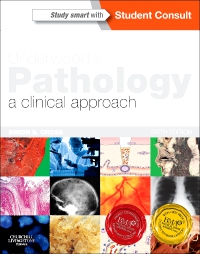

Underwood's Pathology: a Clinical Approach - Elsevier eBook on Vitalsource, 6th Edition
Elsevier eBook on VitalSource
New Edition Expected Availability: 04-13-2018

Underwood's Pathology. Elsevier eBook on Vitalsource
-
- Fully revised throughout, with several new contributors and re-written chapters.
- Structure of chapters honed to make the book even easier to use during courses that are problem- or case-based.
- Access to extensive companion website on Student Consult:
- Fully searchable complete eletronic text
- Downloadable image bank
- Ability to add your own notes
- Over 250 review questions and clinical cases to assess your strengths and weaknesses and help apply learning to clinical practice
- Core topics further explained and brought to life with extra video and podcast tutorials
- Test yourself with bonus pathology crosswords
- Search across all the Student Consult resources you own online and in one place
-
- Supply students with content that perfectly matches their needs, offered via a clinical approach that's ideally suited to integrated courses.
Emphasize the normal structure and function of organ systems that are important to an understanding of the subsequently discussed disease processes. - Provide an unrivalled collection of clinical photographs, histopathology images, and graphics, approximately 700 in all, that richly depict the appearance of both healthy and diseased tissues.
- Supply students with content that perfectly matches their needs, offered via a clinical approach that's ideally suited to integrated courses.
-
PART 1 BASIC PATHOLOGY
1 What is pathology?
2 What is disease?
3 What causes disease?
PART 2 DISEASE MECHANISMS
4 Disorders of growth, differentiation and morphogenesis
5 Responses to cellular injury
6 Disorders of metabolism and homeostasis
7 Ischaemia, infarction and shock
8 Immunology and immunopathology
9 Inflammation
10 Carcinogenesis and neoplasia
11 Ageing and death
12 How do pathologists help patient care?
PART 3 SYSTEMATIC PATHOLOGY
13 Cardiovascular system
14 Respiratory tract
15 Alimentary system
16 Liver, biliary system and exocrine pancreas
17 Endocrine system
18 Breast
19 Female genital tract
20 Urinary and male genital tracts
21 Kidney diseases
22 Lymph nodes and extranodal lymphoid tissue, spleen and thymus
23 Blood and bone marrow
24 Skin
25 Osteoarticular and connective tissues
26 Central and peripheral nervous systems
-
-
Ways of Reading
- The appearance of the text and page layout can be modified according to the capabilities of the reading system (font family and font size, spaces between paragraphs, sentences, words, and letters, as well as color of background and text)
- This e-publication is accessible to the full extent that the file format and types of content allow, on a specific reading device, by default, without necessarily including any additions such as textual descriptions of images or enhanced navigation
- No information about nonvisual reading is available
-
Conformance
- The publication was certified on 27-05-2026
-
Navigation
- Table of contents to all chapters of the text via links
- Page list to go to pages from the print source version
-
Rich Content
- No information is available
-
Hazards
- No information is available
-
Product Content
- No information is available
-
Legal Considerations
- No information is available
-
Additional Accessibility Information
- Page breaks included from the original print source
- For readers with color vision deficiency, use of color (e.g., in diagrams, graphics and charts, in prompts, or on buttons inviting a response) is not the sole means of graphical distinction or of conveying information
- E-publication includes basic navigation (usually less detailed than TOC-based navigation)
- Where links, controls or buttons are included in the content, the purpose or functionality of each link, control or button is apparent from the associated text alone - or where it is unclear, separate link, control or button descriptions are provided
- All (or substantially all) textual matter is arranged in a single logical reading order (including text that is visually presented as separate from the main text flow, e.g., in boxouts, captions, tables, footnotes, endnotes, citations, etc.). Non-textual content is also linked from within this logical reading order. (Purely decorative non-text content can be ignored).
- The language of the text has been specified (e.g., via the HTML or XML lang attribute) to optimise text-to-speech (and other alternative renderings), both at the whole document level and, where appropriate, for individual words, phrases or passages in a different language.
-
Ways of Reading

 as described in our