ISBN:
9780323811644
Copyright:
2025
Publication Date:
10-11-2024
Page Count:
1200
Imprint:
Elsevier
List Price:
$90.99

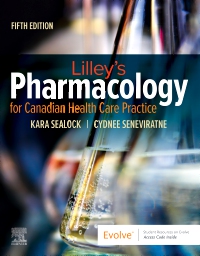
Lilley's Pharmacology for Canadian Health Care Practice - Elsevier eBook on VitalSource, 5th Edition
by Kara Sealock, RN, BN, MEd, EdD and Cydnee Seneviratne, RN, BScN, MN, PhD
Elsevier eBook on VitalSource
ISBN:
9780323811644
Copyright:
2025
Publication Date:
10-11-2024
Page Count:
1200
Imprint:
Elsevier
List Price:
$90.99
Was
$90.99
Now $63.69
Or $0.00 with a valid access code
Let Canada’s #1 pharmacology text guide you in mastering the complicated world of nursing pharmacology! Now in its fifth edition, Lilley’s Pharmacology for Canadian Health Care Practice covers all the key pharmacology content needed by today’s Canadian nurses. Known for its vibrant design, abundance of visuals, and wealth of helpful feature boxes, this engaging text brings important pharmacology concepts to life. The book’s popular and unique key drug approach focuses on the drug information you need to know to safely and effectively administer drugs. Providing exam preparation and insightful learning strategies, this complete (and proven) pharmacology text helps you succeed in school, clinicals, and professional practice.
-
- NEW! Nora AI - an AI-powered learning assistant exclusive to Elsevier ebooks on VitalSource's Bookshelf® platform - offers built-in AI learning support that provides personalized answers based on content from the Elsevier ebook
- UPDATED! Thoroughly updated drug content reflects the latest Health Canada drug approvals, withdrawals, and therapeutic uses, as well as corresponding updated nursing content
- UPDATED! Coverage of current top-of-mind topics includes the new 2023 COPD definition, new asthma recommendations and guidelines, the impact of COVID-19 on respiratory diseases and management, pharmacology as it pertains to palliative care, updated marijuana information for both medical and recreational purposes, issues surrounding the use and misuse of fentanyl and the take-home distribution of naloxone kits used to tackle the growing fentanyl crises, and more
- NEW! The latest Canadian statistics, research, legislation, regulations, and clinical practice guidelines are incorporated throughout the text as well as content reflecting the 2017 CNA Code of Ethics, updated references, and more
- Comprehensive visual program incorporates diagrams, graphs, charts, and photos throughout the text to accompany difficult concepts and theories and help facilitate learning
- Consistent and colourful reader-friendly format utilizes summary tables and a practical body systems organization to integrate pharmacology content with what you are learning in medical-surgical and adult health nursing courses
- Practice questions for the Next Generation NCLEX® are included on the companion Evolve website
- Popular key drug approach focuses on need-to-know content for safe clinical practice, using a streamlined approach to drug indications and emphasizing only the most common or serious adverse effects
- Focus on prioritization connects prioritized nursing diagnoses to a corresponding prioritization of goals and outcomes
- Case studies reflect real-world scenarios and the diverse Canadian population
- Incorporation of the Truth and Reconciliation Commission of Canada’s Calls to Action covers Indigenous health and healing practices, an explanation of the Indigenous medicine wheel, and alternative medicinal interventions
- Examination review questions help you more thoroughly prepare for credentialling exams
- Cartoon-illustrated study tips on Evolve cover study, time management, and test-taking tips
- Wealth of student-friendly learning aids includes approachable text elements such as:
- Case studies throughout the text that help bring patients to life
- Drug profiles highlighting specific information on commonly used agents
- More than 250 full-colour photos and illustrations showing how drugs work in the body and how to administer medications safely and effectively
- Pharmacokinetics tables that include "Elimination Half-Life" information for each drug profile
- Dosages tables providing instant access to dosages, routes, and indications for individual drugs
- Patient Teaching tips outlining useful patient information specific to each drug group
- Evidence in Practice boxes featuring current research and findings relevant to nursing pharmacology
- Lab Values Related to Drug Therapy summary boxes covering therapeutic levels of various drugs
- Preventing Medication Errors boxes reinforcing concepts and relating them to specific common errors that occur in nursing pharmacology
- Ethnocultural Implications boxes discussing differences to expect among cultural or ethnic groups
- Natural Health Products boxes providing an Overview, Common Uses, Adverse Effects, Potential Drug Interactions, and Contraindications for popular herbal therapies
- Special Populations Considerations boxes highlighting critical points related to drug therapy in children, adolescents, women and older adult patients
- Legal and Ethical Principles boxes promoting awareness of liability issues and proper professional conduct
- Pharmacokinetic Bridge to Nursing Practice covering topics such as heart failure, women’s health issues, iron, and monitoring renal function
- Key points summarizing the most important pharmacology and nursing content in each chapter
- Examination review questions in every chapter
-
-

-

-
 Study Guide for Lilley's Pharmacology for Canadian Health Care Practice - Elsevier eBook on VitalSourceElsevier eBook on VitalSource
 -

-

-
-
PART 1 Pharmacology Basics
1. Nursing Practice in Canada and Drug Therapy
2. Pharmacological Principles
3. Legal and Ethical Considerations
4. Patient-Focused Considerations
5. Gene Therapy and Pharmacogenomics
6. Medication Errors: Preventing and Responding
7. Patient Education and Drug Therapy
8. Over-the-Counter Drugs and Natural Health Products
9. Vitamins and Minerals
10. Principles of Drug Administration
PART 2 Drugs Affecting the Central Nervous System
11. Analgesic Drugs
12. General and Local Anaesthetics
13. Central Nervous System Depressants and Muscle
14. Central Nervous System Stimulants and Related Drugs
15. Antiepileptic Drugs
16. Antiparkinsonian Drugs
17. Psychotherapeutic Drugs
18. Substance Use Disorder
PART 3 Drugs Affecting the Autonomic Nervous
System
19. Adrenergic Drugs
20. Adrenergic-Blocking Drugs
21. Cholinergic Drugs
22. Cholinergic-Blocking Drugs
PART 4 Drugs Affecting the Cardiovascular and Renal System
23. Antihypertensive Drugs
24. Antianginal Drugs
25. Heart Failure Drugs
26. Diuretic Drugs
27. Antidysrhythmic Drugs
28. Coagulation Modifier Drugs
29. Antilipemic Drugs
30. Fluids and Electrolytes
PART 5 Drugs Affecting the Endocrine System
31. Pituitary Drugs
32. Thyroid and Antithyroid Drugs
33. Antidiabetic Drugs
34. Adrenal Drugs
35. Women’s Health Drugs
36. Men’s Health Drugs
PART 6 Drugs Affecting the Respiratory System
37. Antihistamines
38. Respiratory Drugs
PART 7 Drugs Affecting the Gastrointestinal
System and Nutrition
39. Acid-Controlling Drugs
40. Antidiarrheal Drugs and Laxatives
41. Antiemetic and Antinausea Drugs
42. Nutritional Supplements
PART 8 Anti-Infective and Anti-Inflammatory Drugs
43. Antibiotics Part 1: Sulfonamides, Penicillins,
44. Antibiotics Part 2: Aminoglycosides, Fluoroquinolones, and Other Drugs
45. Antiviral Drugs
46. Antitubercular Drugs
47. Antifungal Drugs
48. Antimalarial, Antiprotozoal, and Anthelmintic Drugs
49. Anti-Inflammatory and Antigout Drugs
PART 9 Immune and Biological Modifiers and
Chemotherapeutic Drugs
50. Immunosuppressant Drugs
51. Immunizing Drugs and Pandemic Preparedness
52. Antineoplastic Drugs Part 1: Cancer Overview and Cell
53. Antineoplastic Drugs Part 2: Cell Cycle–Nonspecific and
54. Biological Response–Modifying Drugs and Antirheumatic
PART 10 Miscellaneous Therapeutics: Hematological, Ophthalmic, and Otic Drugs
55. Anemia Drugs
56. Dermatological Drugs
57. Ophthalmic Drugs
58. Otic Drugs -
-
Ways of Reading
- The appearance of the text and page layout can be modified according to the capabilities of the reading system (font family and font size, spaces between paragraphs, sentences, words, and letters, as well as color of background and text)
- This e-publication is accessible to the full extent that the file format and types of content allow, on a specific reading device, by default, without necessarily including any additions such as textual descriptions of images or enhanced navigation
- All content can be read as read aloud speech or dynamic braille
- Has alternative text descriptions for images
-
Conformance
- The certifier's credential is https://bornaccessible.benetech.org/certified-publishers/
- The publication was certified on 24-03-2026
-
Navigation
- Table of contents to all chapters of the text via links
- Index with links to referenced entries
- Elements such as headings, tables, etc. for structured navigation
- Page list to go to pages from the print source version
-
Rich Content
- Math formulas in accessible format (MathML)
- Information-rich images are described by extended descriptions
-
Hazards
- The publication contains no hazards
-
Product Content
- Content includes any type of illustrations.
- The primary content is text.
- Content includes maps and/or other cartographic content.
- Content includes a significant number of actionable (clickable) web links to external content, downloadable resources, supplementary material, etc.
- Content includes a significant number of actionable (clickable) cross-references, hyperlinked notes and annotations, or with other actionable links between largely textual elements (e.g., quiz/test questions, 'choose your own ending', etc.).
- Content includes photographs, whether in a plate section / insert or not.
- Content includes figures, diagrams, charts and/or graphs, including other 'mechanical' (i.e. non-photographic) illustrations.
- Content includes images displayed in a specific order for the purpose of graphic storytelling or giving information (e.g. graphic novels, comics and manga). May include text integrated into the image (as speech and thought bubbles, textual 'sound' effects, captions etc.).
- Content includes text within images, including text-as-text embedded in diagrams, charts, or within images containing speech balloons, thought bubbles, captions, etc.
- Content includes visual content that is purely decorative and is not necessary to understanding of the content.
- Content includes chemical notations, formulae.
- Content includes mathematical notations, formulae.
- At least some text - including text within other images - is 'text as an image' (i.e., a picture of text).
-
Legal Considerations
- No information is available
-
Additional Accessibility Information
- Content is enhanced with ARIA roles to optimize organization and facilitate navigation
- Page breaks included from the original print source
- For readers with color vision deficiency, use of color (e.g., in diagrams, graphics and charts, in prompts, or on buttons inviting a response) is not the sole means of graphical distinction or of conveying information
- The body text is presented with a contrast ratio of at least 4.5:1 (or 3:1 for large/heading text)
- Ultra-high contrast between text and background
- E-publication includes basic navigation (usually less detailed than TOC-based navigation)
- Where links, controls or buttons are included in the content, the purpose or functionality of each link, control or button is apparent from the associated text alone - or where it is unclear, separate link, control or button descriptions are provided
- All (or substantially all) textual matter is arranged in a single logical reading order (including text that is visually presented as separate from the main text flow, e.g., in boxouts, captions, tables, footnotes, endnotes, citations, etc.). Non-textual content is also linked from within this logical reading order. (Purely decorative non-text content can be ignored).
- Content provides explanations for unusual words, abbreviations, acronyms, idioms, jargon in an accessible form, such as glossaries, scripted pop-ups.
- Where interactive content is included in the product, controls are provided (e.g., for speed, pause and resume, reset) and labelled to make their use clear.
- The language of the text has been specified (e.g., via the HTML or XML lang attribute) to optimise text-to-speech (and other alternative renderings), both at the whole document level and, where appropriate, for individual words, phrases or passages in a different language.
-
Ways of Reading
Was
$90.99
Now $63.69
Or $0.00 with a valid access code

 as described in our