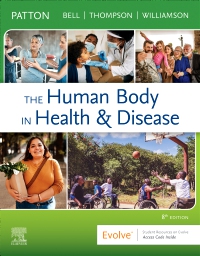

The Human Body in Health & Disease - Elsevier eBook on VitalSource, 8th Edition
Elsevier eBook on VitalSource
Now $56.69
Completely revised and updated, The Human Body in Health & Disease, 8th Edition makes it easier to understand how the body works, both in typical conditions and when things change. Its easy-to-read writing style, more than 500 full-color illustrations, and unique Clear View of the Human Body transparencies keep you focused on the principles of anatomy, physiology, and pathology. Key features are Connect It! with bonus online content, concept maps with flow charts to simplify complex topics, and chapter objectives and active learning sections. From noted educator Kevin Patton, this book presents A&P in a way that lets you know and understand what is important.
-
- NEW! Nora AI - an AI-powered learning assistant exclusive to Elsevier ebooks on VitalSource's Bookshelf® platform - offers built-in AI learning support that provides personalized answers based on content from the Elsevier ebook
- More than 500 full-color photographs and drawings illustrate the most current scientific knowledge and bring difficult concepts to life. The beautifully rendered illustrations are unified by a consistent color key and represent a diversity of human identity
- A conversational writing style is paired with "chunked" content, making it easy to read and comprehend
- UNIQUE! Creative page design uses color backgrounds to organize information in a more inviting, accessible, and motivating way to enhance learning
- UNIQUE! The full-color, semi-transparent Clear View of the Human Body permits the on-demand virtual dissection of typical male and female human bodies along several body planes. This 22-page insert contains a series of transparencies that allows you to peel back the layers of the body anterior-to-posterior and posterior-to-anterior
- Language of Science/Language of Medicine word lists at the beginning of chapters present key terms, pronunciations, and word-part translations to help you become familiar with new and complex terminology
- Animation Direct feature throughout the text guides you to state-of-the-art animations on the companion Evolve website to provide dynamic visual explanations of key concepts
- Active Concept Maps offer animated, narrated walk-throughs of concept maps to clarify the text narrative and provide you with clear examples of how to build your own concept maps
-
-
 Study Guide for The Human Body in Health & Disease - Elsevier eBook on VitalSourceElsevier eBook on VitalSource
 -

-

-

-

-
-
1. Introduction to the Body
2. Chemistry of Life
3. Cells
4. Tissues
5. Organ Systems
6. Mechanisms of Disease
7. Skin and Membranes
8. Skeletal System
9. Muscular System
10. Nervous System
11. Senses
12. Endocrine System
13. Blood
14. Heart and Heart Disease
15. Circulation of Blood
16. Lymphatic System and Immunity
17. Respiratory System
18. Digestive System
19. Nutrition and Metabolism
20. Urinary System
21. Fluid and Electrolyte Balance
22. Acid–Base Balance
23. Reproductive Systems
24. Growth, Development, and Aging
25. Genetics and Genetic Diseases -
-
Ways of Reading
- The appearance of the text and page layout can be modified according to the capabilities of the reading system (font family and font size, spaces between paragraphs, sentences, words, and letters, as well as color of background and text)
- This e-publication is accessible to the full extent that the file format and types of content allow, on a specific reading device, by default, without necessarily including any additions such as textual descriptions of images or enhanced navigation
- No information about nonvisual reading is available
-
Conformance
- For detailed accessibility information, see Elsevier's website at https://www.elsevier.com/about/accessibility
- For queries regarding accessibility information, contact [email protected]
- The publication was certified on 18-11-2025
-
Navigation
- Table of contents to all chapters of the text via links
-
Rich Content
- No information is available
-
Hazards
- No information is available
-
Product Content
- No information is available
-
Legal Considerations
- No information is available
-
Additional Accessibility Information
- For readers with color vision deficiency, use of color (e.g., in diagrams, graphics and charts, in prompts, or on buttons inviting a response) is not the sole means of graphical distinction or of conveying information
- E-publication includes basic navigation (usually less detailed than TOC-based navigation)
- Where links, controls or buttons are included in the content, the purpose or functionality of each link, control or button is apparent from the associated text alone - or where it is unclear, separate link, control or button descriptions are provided
- All (or substantially all) textual matter is arranged in a single logical reading order (including text that is visually presented as separate from the main text flow, e.g., in boxouts, captions, tables, footnotes, endnotes, citations, etc.). Non-textual content is also linked from within this logical reading order. (Purely decorative non-text content can be ignored).
- The language of the text has been specified (e.g., via the HTML or XML lang attribute) to optimise text-to-speech (and other alternative renderings), both at the whole document level and, where appropriate, for individual words, phrases or passages in a different language.
-
Ways of Reading

 as described in our